Select a site alphabetically from the choices shown in the box below. Alternatively, browse sculptural examples using the Forward/Back buttons.
Chapters for this volume, along with copies of original in-text images, are available here.


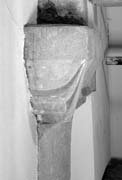
Object type: Capital
Measurements: H. 38 cm (15 in) (incl. top of shaft); W. 75 cm (29.5 in) of which 55 cm (21.6 in) is carved and the rest is cut back. D. (to face of arch blocking): 23 cm (9 in) at top; 15 cm (5.9 in) at top of 'keel'; 10 cm (3.9 in) to western face of column (overall depth unknown due to blocking of arch).
Stone type: Greyish yellow (5Y 8/4) grain supported muddy oolite with some hollow ooliths which range in size from 0.2 to 0.8 mm. Faint bedding parallel to slab. Cleeve Cloud Member, Birdlip Limestone Formation, Inferior Oolite Group, Middle Jurassic.
Plate numbers in printed volume: Ills. 218-21, 225; Figs. 21A, 36
Corpus volume reference: Vol 10 p. 189-90
(There may be more views or larger images available for this item. Click on the thumbnail image to view.)
In situ. Noted in present position by Haigh (1846, 17) and Butterworth (1862, 95) and visible in a drawing made during the restoration of 1861–2 (Strickland 1862).
Capital for southern respond column of the chancel arch. The capital rises from the three-quarter-round column up through two sharply profiled horizontal fillets (the lower one with a right-angle cross-section and one upper one V-shaped). Above these fillets the capital curves out before reaching the plain, almost vertical face of a rectangular impost or 'false abacus'. The transition from the round column to the rectangular upper part of the capital is emphasised by distinctive, upward-sweeping mouldings on the corners between the south and north faces and between the north and east faces (outside the present blocking). The mouldings taper as they rise to end in sharp points just below the lower edge of the outer corners of the impost. The mouldings terminate the lower fillet on each face and incorporate the upward-sweeping ends of the upper fillet. In elevation they look rather like the stem of a ship. However, when one reconstructs the capital as it would have looked before the blocking wall was built, the corner mouldings appear to be more like horns. The surface of the stone is smoothed and was almost certainly painted, although no pigment now survives.
Nothing quite like the Deerhurst capitals exists elsewhere. They belong to the Period IV church and therefore date to the first half of the ninth century (see discussions for Deerhurst St Mary 4, 13 and 18). The sweeping shape of the clasping corner-mouldings has often been compared with the stem of an Anglo-Saxon ship, most recently by Gem — although he rightly adds that this does not necessarily mean that a nautical reference was intended by the sculptor (Gem et al. 2008, 132). However, Deerhurst's proximity to the River Severn and the recurring Gospel image of the fishing boat mean that this suggestion should not be dismissed altogether. Alternatively the shapes might represent horns (as indicated above in the description) or the points of a crown around each capital, symbolising perhaps the royal authority of Christ.
