Select a site alphabetically from the choices shown in the box below. Alternatively, browse sculptural examples using the Forward/Back buttons.
Chapters for this volume, along with copies of original in-text images, are available here.


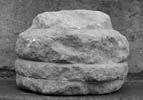
Object type: Capital or base
Measurements: H. 21 cm (8.3 in); Diam. (max.) 30 > 28 cm (11.8 > 11 in)
Stone type: Yellowish grey (5Y 8/1) sparry matrix supported oolite. Small amount of shell debris. Oolith size 0.2 to 0.8 mm. Shell debris up to 2 mm. Cleeve Cloud Member, Birdlip Limestone Formation, Inferior Oolite Group, Middle Jurassic.
Plate numbers in printed volume: Ills. 461-6
Corpus volume reference: Vol 10 p. 258-9
(There may be more views or larger images available for this item. Click on the thumbnail image to view.)
Capital (or possibly a base) found in excavations but from a context that could not be closely dated. The stone carries three roll mouldings, the middle of which has an incised groove around it. Below the roll mouldings the stone tapers to a damaged area which, on the evidence of parallels offered below, was probably another roll moulding that acted as a collar. There is a shallow square socket (6.5 cm across and 2 cm deep) in the centre of the 'top' face of the stone (face E), and a small part of an integrated shaft survives on the 'bottom' face (face F). The mouldings are cut back on one side to form a roughly flat face, suggesting that, perhaps in a secondary stage, the stone was adapted to form part of a respond shaft.
Appendix A item (stones dating from Saxo-Norman overlap period or of uncertain date).
This stone is very similar in profile to several of the tenth- or early eleventh-century capitals reused in blind arcading in the eastern slype at Worcester Cathedral (see this volume Worcester Cathedral 3a–x, Ills. 677–701). It is also similar to the capitals/bases of reused baluster shafts from St Albans Cathedral dated to the tenth century or earlier (Tweddle et al. 1995, 236–40, fig. 34, ills. 376–96). Capitals and bases of this type are also common in fictive representations of arches in manuscripts, for example on fols. 24v, 34v, 99v, 118v from the Benedictional of St Æthelwold (BL, Add. MS 49598: Prescott 2002) or on fol.1v of Bede, Lives of St Cuthbert (Cambridge, Corpus Christi College MS 183: Temple 1976, 37–8, cat. 6, ill. 29).
