Select a site alphabetically from the choices shown in the box below. Alternatively, browse sculptural examples using the Forward/Back buttons.
Chapters for this volume, along with copies of original in-text images, are available here.


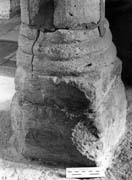
Object type: Base (or capital)
Measurements: H. 20 < 21 cm (7.9 < 8.3 in); W. (square base) 28 cm (11 in); Diameter (where it joins column) c.23 cm (9 in)
Stone type: Yellowish grey (5Y 8/1), sparry matrix supported oolite. A few shell fragments. Ooliths 0.2 to 0.8 mm. Column above is similar but with more shell debris. Cleeve Cloud Member, Birdlip Limestone Formation, Inferior Oolite Group, Middle Jurassic.
Plate numbers in printed volume: Ill. 467
Corpus volume reference: Vol 10 p. 259
(There may be more views or larger images available for this item. Click on the thumbnail image to view.)
Base (or capital) reused as the base of a stone shaft which carries an early Norman volute capital. The stone itself has a square base and then tapers upwards through three roll mouldings that are circular in plan. The base sits on a raised stone block and the whole column supports a major wooden beam.
Appendix A item (stones dating from Saxo-Norman overlap period or of uncertain date).
The profiles of the roll mouldings on this stone are very similar to Deerhurst St Mary 26 above. They are also similar in scale. This base could, therefore, be contemporary with no. 26, the differences between the two being because one is probably a base and one a capital. However, the integral square basal block (or abacus if it was originally a capital) is not a normal feature of the late Anglo-Saxon capitals and bases to which no. 26 has been compared. Malcolm Thurlby considers that the complete ensemble (base, column and Norman volute capital) should be viewed as contemporary and of late eleventh- or early twelfth-century date (Thurlby, pers. comm.).
