Select a site alphabetically from the choices shown in the box below. Alternatively, browse sculptural examples using the Forward/Back buttons.
Chapters for this volume, along with copies of original in-text images, are available here.


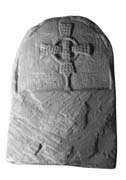
Object type: Grave-marker
Measurements: H. 48 cm (18.9 in); W. 34.5 cm. (13.6 in); D. unknown
Stone type: Pinkish grey (5R 7/1), hard, well sorted, fine to medium-grained sandstone. Quartz, commonly stained pink, is the dominant grain type (0.2 to 0.5 mm) along with some mica in common with Diddlebury 1 and 2. This stone has also been painted. Possibly Clee Sandstone Formation, Woodbank Group, Lower Old Red Sandstone (Lower Devonian) or Farlow Group, Upper Old Red Sandstone (Upper Devonian).
Plate numbers in printed volume: Ills. 577-8
Corpus volume reference: Vol 10 p. 322-3
(There may be more views or larger images available for this item. Click on the thumbnail image to view.)
Headstone with a semi-circular top.
A (broad): In the upper part is a ringed cross in low relief. This equal-arm cross stands on a small and very narrow columnar pedestal. The arms of the cross are wedge-shaped (type B6) and covered with close-set rows of small square recesses rather like the surface of a shortbread biscuit. The ring tightly encircles the middle of the cross-head, and the two horizontal and vertical arms are interlocked with the ring and each other. The background around the cross is recessed by 1 cm (0.4 in), with an outer edge moulding, and the lower 22.5 cm (8.8 in) of the stone is uncarved.
B and D (narrow): Plain
C (broad): The upper part is covered by a tight, regular mesh of hollow-centred squares rather like a honeycomb — twelve squares across and a maximum of nine high. The lower half is again uncarved.
E (top): The curving top of the stone carries four narrow roll-mouldings, parallel to one another, which rise from a little above the level of the bottom of the recessed area on the main face.
Appendix A item (stones dating from Saxo-Norman overlap period or of uncertain date)
The small cross on this headstone is unusual in that the vertical arms overlap the horizontal arms, and both are then held in place by being 'woven' through the ring. The short, slender stem is rather similar to the narrow stems on two cross-head panels (eleventh century or late seventh century) from Monkwearmouth, Co. Durham (Cramp 1984, 133–4, pl. 116.619–20). It may be the top part of a processional cross-shaft, like those on a late eleventh-century font from Cawthorne in western Yorkshire (Coatsworth 2008, 275–6, ills. 809–10), but it has a capital and base and looks more like a pedestal. It seems possible that this carving is in fact a copy of a cross-reliquary set on a pedestal, as might also be suggested for the cross that stands on a rather more elaborate base, on an eleventh-century grave-cover from Weyhill, Hampshire (Tweddle et al. 1995, 269–70, ill. 473).
