Select a site alphabetically from the choices shown in the box below. Alternatively, browse sculptural examples using the Forward/Back buttons.
Chapters for this volume, along with copies of original in-text images, are available here.


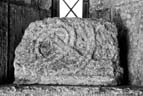
Object type: Cross-shaft fragment
Measurements: H. 39.5 cm (15.5 in); W. 23 cm (9 in); D. 13 cm (5.1 in)
Stone type: Pinkish grey (5YR 8/1), matrix-supported, micritic, shelly oolite. Ooliths are medium-grained in the range 0.2 to 0.3 mm and have weathered or fallen out to give an 'aero-chocolate' texture. Bivalve shells up to 4 cm are common and are mostly irregularly arranged (including near vertical), but sufficient are crudely aligned to pick out horizontal bedding. Cleeve Cloud Member, Birdlip Limestone Formation, Inferior Oolite, Group, Jurassic. The presence of the bivalve Propeamussium sp. suggests an origin low in the Cleeve Cloud Member.
Plate numbers in printed volume: Ill. 240
Corpus volume reference: Vol 10 p. 197-8
(There may be more views or larger images available for this item. Click on the thumbnail image to view.)
None. First noted by Daubeny (1921, 208).
Fragment of what is probably a cross-shaft, decorated with loose strands of median-incised interlace on face A. One edge survives with a simple square-section moulding that is partly obscured by the mortar used to fix the fragment to the window sill. There is no indication of carving on the small portion of face D that is visible, the rest being also obscured by the fixing mortar. The stone has been roughly split vertically so that neither face B nor face C survives.
The scale of the interlace on this fragment and the width of the primary face both suggest that this cross was quite large. The cross pre-dates the late Anglo-Saxon church of St Mary which is set in a fairly remote valley about five miles from Cirencester. There is no pre-Conquest historical evidence for Edgeworth; for further discussion as to the possible context of ninth-century sculpture at this site, see Chapter III (p. 21).
