Select a site alphabetically from the choices shown in the box below. Alternatively, browse sculptural examples using the Forward/Back buttons.
Chapters for this volume, along with copies of original in-text images, are available here.


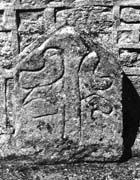
Object type: Grave-marker
Measurements: H. 48 cm (18.9 in); W. 37 > 35 cm (14.5 > 13.8 in); D. 9.5 > 8.5 cm (3.7 > 3.3 in)
Stone type: Oolite with grains supported in a sparry matrix supported. Ooliths range in size from 0.2 to 0.6 mm. The stone was so heavily encrusted with lichen and algae that the true colour was not discernible. Cleeve Cloud Member, Birdlip Limestone Formation, Inferior Oolite Group, Middle Jurassic.
Plate numbers in printed volume: Ill. 241
Corpus volume reference: Vol 10 p. 198
(There may be more views or larger images available for this item. Click on the thumbnail image to view.)
None. Probably among the various 'incised sepulchral stones and coffin covers' noted by Daubeny (1921, 208) as being set against the south walls of chancel and nave. First noted by MacKay (1963, 91).
Triangular-headed grave-marker, with poorly executed carving of what seem to be opposed birds set on either side of a vertical shaft. Below the 'birds' there are curving shapes that might be intended to represent foliage. The other faces are plain.
This small grave-marker is unlike any of the later medieval grave stones and markers that have also been set against the south wall of the church. In shape it is more like one of the many small Roman altars from the Cotswold region, and it may indeed be a reused altar stone. However, opposed birds are a common Anglo-Saxon motif, with local examples including Berkeley Castle 2 (Ills. 17–18) and Gloucester St Oswald 1 and 2 (Ills. 265, 268, 274). It is suggested that this is a 'rustic' version of one of the more accomplished local pieces.
