Select a site alphabetically from the choices shown in the box below. Alternatively, browse sculptural examples using the Forward/Back buttons.
Chapters for this volume, along with copies of original in-text images, are available here.


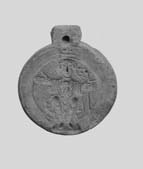
Object type: Seal matrix
Measurements: H. (including hanging loop) 6.5 cm (2.6 in); W. (diameter) 5.8 cm (2.3 in); D. 1.3 cm (0.5 in)
Stone type: Greyish orange pink (10R 8/2) very fine muddy sandstone to siltstone with grains c. 0.05 to 100 mm in size. Some grains possibly quartz have a shiny lustre. This could be from the Mercia Mudstone but could be a fired ceramic body perhaps derived from Mercia Mudstone.
Plate numbers in printed volume: Ills. 722-8
Corpus volume reference: Vol 10 p. 373-4
(There may be more views or larger images available for this item. Click on the thumbnail image to view.)
Found among the possessions of Mrs Dora Griffin (who died c. 1974) and who had lived in Hampton, one mile from Evesham, and transferred to the Almonry Museum, Evesham in 1982. Mrs Griffin and her husband had been long-term residents of Hampton and are believed to have been descended from local families (Cox and Heslop 1984, 396).
Seal matrix, slightly raised in the centre and bearing the image of a seated abbot or bishop with a foliate crosier, but the figure is un-mitred, perhaps suggesting that he is an abbot rather than a bishop. His arms are spread wide and he wears a full-length robe that is draped over his raised knees. He also wears a long and rather voluminous over-garment that is fastened in the middle of his chest with a large, rectangular clasp or brooch. The over-garment has full sleeves, and falls in heavy folds on either side of the figure. His feet are set on a raised plinth. There is no sign of the seat on which the figure is sitting. A cross and a single 'A' is all that survives of the inscription on the front face of the matrix. There is an incomplete inscription around the edge. The back is covered with scratched signs and various initials.
Inscription Elisebeth Okasha published the following transcription of the two inscriptions (Okasha 1992, 45).
i: + [... A ...]|
ii: [.]A [I]T[.]I [F ... . . .][. ... I]TIES[V]S|
Appendix A item (stones dating from Saxo-Norman overlap period or of uncertain date)
This seal matrix could be late Anglo-Saxon or very early post-Conquest. The later seals of abbots and priors are almost always pointed ovals rather than circular, and the figure holds a book as well as a crozier. The Evesham seal matrix is more like that belonging to Bishop Wulfstan from Worcester. Cox and Heslop (1984) suggested that it could belong to 'the generation immediately after the Norman Conquest', but it might also be from the period preceding the Conquest.
Inscription Okasha (1992, 45) interpreted the inscriptions as follows:
'On text i only the initial cross is legible although traces of A and of another letter remain. A [seal-matrix] text would be expected to have laterally displaced letters and to read anti-clockwise, but the text is too illegible to confirm this. The text may have been deliberately defaced, perhaps to invalidate it. Text ii is highly deteriorated but whether through deliberate defacing or through wear is not clear. Text ii reads [.]A[I]T[.]I[F...] [...I]TIES[V]S|. The final word may have been IES[V]S.'
Cox and Heslop suggested that the surviving letters around the edge of the matrix seem to be part of a motto AIT . . . IESVS, 'Jesus says . . .' but the substance is missing.
