Select a site alphabetically from the choices shown in the box below. Alternatively, browse sculptural examples using the Forward/Back buttons.
Chapters for this volume, along with copies of original in-text images, are available here.


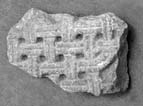
Object type: Fragment of panel
Measurements: H. 10 cm (3.9 in); W. 14.5 cm (5.7 in); D. 4.5 cm (1.8 in)
Stone type: Yellowish grey (5Y 8/1) grain supported oolite with a sparry matrix. Few hollow ooliths. Ooliths 0.5 to 1.1 mm in size. Fairly shelly with debris 2–5 mm in size. Cleeve Cloud Member, Birdlip Limestone Formation, Inferior Oolite Group, Middle Jurassic.
Plate numbers in printed volume: Ill. 634
Corpus volume reference: Vol 10 p. 357
(There may be more views or larger images available for this item. Click on the thumbnail image to view.)
There is no record of the provenance of this item at the Almonry Museum (pers. comm. Tonia Byrd 13 July 2009), but it is evident that this stone arrived at the museum in 1965 with the rest of the Rudge collection of worked stone. We are much indebted to Anthony Rudge (pers. comms. 26 and 29 July 2009) for providing us with a copy of a drawing of this stone made by Anne Rudge. The drawing is undated, but Anne Rudge died on 1 September 1836. The worked stone in the Rudge collection came mainly from excavations on the site of the church of Evesham Abbey and some of the east range of the cloister between 1811 and 1832; these excavations were carried out by Edward Rudge (husband of Anne Rudge) and his son, Edward John Rudge. The collection also included some worked stones dug up between 1828 and 1833 on the site of the cloister by the then owner of that part of the site, William Welch. In addition the collection may have included some worked stones retrieved when the parish church of St Lawrence was restored in 1836–7, though only a font is known with certainty to have made its way into the Rudge collection from this source (pers. comms. David Cox 18 July and 14 August 2009; see also Cox 2010). It is almost, if not quite, certain that this fragment comes from the main excavations on the site of the abbey and cloisters; it seems very unlikely that the stone comes from St Lawrence, given the date of Anne Rudge's death and the fact that old walls were repaired rather than rebuilt during the restoration.
Fragment of panel with multiple strand, median-incised interlace carved in shallow relief.
It seems likely that this small fragment comes from Evesham's important Anglo-Saxon minster. The carving is of good quality, well controlled and carefully laid out. Evesham was one of a series of major minster churches along the Avon valley. It was apparently established in the early eighth century, though its early history is shadowy (Sims-Williams 1990, 141–2, 144, 173–4; Lapidge 2009, lxxxii–xciii). Benedictine monks were installed under King Edgar, probably in the 960s, but the monastic community had a chequered history in the late and early eleventh centuries (Barrow 2004, 151–2).
