Select a site alphabetically from the choices shown in the box below. Alternatively, browse sculptural examples using the Forward/Back buttons.
Chapters for this volume, along with copies of original in-text images, are available here.


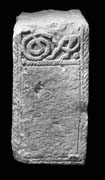
Object type: Lower part of a cross-shaft
Measurements: H. 70 cm (27.5 in); W. 38.6 > 32.2 cm (15.2 > 12.7 in); D. 36.7 > 33 cm (14.4 > 13 in)
Stone type: Yellowish grey (5Y 8/1) grain supported slightly shelly oolite with hollow ooliths ranging in size from 0.2 up to 1.0 mm. Sparse shell debris up to 5 mm. Cleeve Cloud Member, Birdlip Limestone Formation, Inferior Oolite Group, Middle Jurassic.
Plate numbers in printed volume: Ills. 287-91; Figs. 17, 35
Corpus volume reference: Vol 10 p. 210-11
(There may be more views or larger images available for this item. Click on the thumbnail image to view.)
The shaft is edged with a broad outer cable moulding and a fine inner flat moulding. There is a blank panel in the lower part of each face, the two on faces C and D being larger than those on faces A and B. In the centre of the blank panel on face B there is a circular hole, presumably a fixing hole, that slopes down to connect with a socket in the bottom of the shaft.
On three sides of the shaft (faces A, B and C), above the blank areas, there are small panels of mirror-image, symmetrical loop, pattern F interlace, median-incised, with cable moulding above and below the panels.
A: Above the mirror-image panel, there is a second panel which contains the tails of two facing creatures. The tails are hatched and drawn out into median-incised interlace, which then enmeshes the creatures.
B: A similar panel contains a single creature with horse-like back legs and tail, but with a shorter, curving foreleg. The ribs of the creature are defined by hatching, but the body is not outlined. A single strand of median-incised interlace fills the space between the creature's legs and terminates in a triangular leaf that partly overlaps the inner frame of the border.
C: All that survives above the panel of mirror-image interlace is what might be a small, leftward-pointing foot or a broken fragment of interlace.
D: Above the blank panel, there are the back legs of a creature with a long tail that is drawn out between the legs to form a knot of median-incised interlace.
None of the creatures on Gloucester St Oswald 4 survived in their entirety, but the bodies of the pair of interwoven 'ribbon-tailed' creatures' on face A (Ill. 288), and the single creature on face B (Ill. 289, 291), are heavily hatched in a rather 'harsher' style than St Oswald 3. The legs of the creatures on face B and face D are long and thin (Ills. 287, 289), similar to, but not as graceful as the creatures from Newent and Wroxeter (Ills. 396, 400, 562–4). In the Gloucester series, this cross should be dated a little later than St Oswald 3, probably to the middle of the ninth century.
Strangely there are no human figures on the four cross fragments recovered from the site of St Oswald's, even though at Bisley, only about ten miles to the south-east of Gloucester, the Lypiatt Cross provides evidence for figure carving of the highest quality from as early as the eighth century (Bisley Lypiatt 1, pp. 48–9, Fig. 16), and the Tanners' Hall shaft (Gloucester Tanners Hall 1, Ills. 365–70) and the Cathedral Christ panel (Gloucester Cathedral 1, Ills. 252–6) offer fine examples of late eighth- to ninth-century figure carving from the city itself. However, elsewhere in this volume, it is suggested that the cross-shaft fragment from Wotton Pitch (Gloucester London Road 1, Ills. 356–9) could be part of the same monument as Gloucester St Oswald 4 (see p. 105, Fig. 35), and the Wotton Pitch shaft carries a mid ninth-century figure holding a small cross in both hands (Ill. 360).
