Select a site alphabetically from the choices shown in the box below. Alternatively, browse sculptural examples using the Forward/Back buttons.
Chapters for this volume, along with copies of original in-text images, are available here.


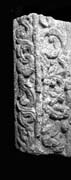
Object type: Carved grave-cover
Measurements: L. 57.5 cm (22.6 in); W. (of stone) 41.8 > 39.7 cm (16.4 > 15.6 in); (of face A) 35.5 > 30.7 cm (14 > 12 in); D. 13.8 cm (5.4 in)
Stone type: Yellowish grey (5Y 8/1) grain supported oolitic shelly limestone in sparry matrix with ooliths up to 0.2 mm in size. Patches of fine-grained sand with ?glauconite possibly just on surface. These may be the remains of a sandy lime wash. Shell debris, consisting of bivalves brachiopods and spines, up to 15 mm. Possibly Taynton Limestone Formation, Great Oolite Group, Middle Jurassic. Known locally as Minchinhampton weatherstone.
Plate numbers in printed volume: Ills. 292-8; Fig. 30A
Corpus volume reference: Vol 10 p. 211-3
(There may be more views or larger images available for this item. Click on the thumbnail image to view.)
(Based upon West 1983, where the stone was published under the original worked stone number 38.) The upper end of this tapering grave-cover is cleanly cut at right angles to the long axis, whilst the lower end is broken. Three surfaces are decorated: the main panel (face A) and the chamfered sections of the edges (faces B and D). Each edge face is separated from the main face by a rounded fillet. The vertical sides and the base (face F) are undecorated and show no evidence of attachment. The decorated surfaces of the slab are almost entirely covered with foliate ornament carved in relief and set against a plain background.
A (broad): The ornament consists of a roughly symmetrical arrangement of foliate motifs around a central element of some complexity. This central stem is broken at two points, at the lower end by a cluster of dots arranged as on a die, and at the upper end by a tri-lobed leaf emanating from a semi-circular cup. From these two points spring the side shoots whose stems and foliate terminals decorate the two halves of the panel.
B (narrow): The chamfer carries a continuous, two-strand running scroll ornamented with side shoots which curl back to overlie the main stems.
D (narrow): As on face B the chamfer carries a two-strand running scroll ornamented with curling side shoots. The scroll is, however, not continuous but is interrupted at two points. The first break is caused by a four-lobed leaf 'collar' which covers the transition of the scroll from a two-strand to a plain stem. This plain stem is, in fact, the neck (or body) of an animal, the head of which curls back to bite the stem just below the leaf collar. The resultant loop causes the second interruption in the running scroll, whilst at the same time acting as a point of departure for a new section of two-strand scroll which is 'hooked' through it.
(including contributions from Jeffrey West)
Gloucester St Oswald 5 and the closely related St Oswald 6 (Ills. 299–300) were cut from different types of oolitic limestone (see Stone Types). Both types have a similar appearance when first cut, but they weather differently and this has probably contributed to the present surface disparity. Relatively few pre-Conquest decorated slabs survive in southern and midland England. While the three decorated slabs on the west tower at Barnack are, perhaps, the best known examples, St Oswald 5 is closely comparable to the tenth- and eleventh-century tapering slabs at Braunton (Devon), Wells (Somerset), Weyhill (Hampshire) and Oxford (Cramp 1975, fig. 20; Cramp 2006, 79–80, 176, ills. 1, 324, 327; Tweddle et al. 1995, 234–5, 269–70, ills. 363, 473). With the exception of Weyhill, the ornamental layout of these slabs is similar to St Oswald 5, and its tapering is also shared by an undecorated grave-slab from the same site (St Oswald 9 and 10, Ills. 306–7); all of which supports the identification of St Oswald 5 as part of a grave-cover. The close similarities of ornament and measurement between St Oswald 5 and 6 indicate that they were carved in the same workshop, if not by the same hand. Indeed, it is possible they could have come from one grave-cover, if, as seems likely, such slabs were sometimes made in two sections. Parallels suggested by West with the ornament of early tenth-century objects and manuscripts (the Cuthbert embroideries, the Alfred Jewel back plate, and Bede's Lives of St Cuthbert frontispiece borders) support a date in the early tenth century, most likely to the 930s (West 1983, 50, figs. 11–13; Battiscombe 1956, pls. XXXI.3, XXXII; Hinton 1974, pl. XI; Temple 1976, ill. 29).
St Oswald's was founded by Ealdorman Æthelred and his wife ÆthelflÆd probably a little before 900 (for Æthelred and his wife, see Chapter II, pp. 12–13). The original dedication was apparently to St Peter, but the foundation became known as St Oswald's after the translation of the relics of St Oswald from Bardney, Lincolnshire, in 909. Æthelred was buried at St Oswald's in 911 and ÆthelflÆd in 918. King Æthelstan seems to have issued a charter of privileges in favour of St Oswald's in 925x6. The history of St Oswald's during the following century is obscure, but by 1033 at the latest St Oswald's was no longer in royal favour, for its lands were used to endow a royal clerk; the causes of the decline are unclear, but it may be that the foundation had shown itself to be in some way an unworthy custodian of the relics of St Oswald and had lost a major part of the relics. In any event St Oswald's was an establishment of only minor importance from this time. A full account of the historical evidence for the early history of St Oswald's will be found in Hare (1999).
The St Oswald's gravestones
Apart from the one unstratified example (Gloucester St Oswald 7) these grave-covers can be said to derive from one context, Walls 48 and 49 of Period III (it is likely that St Oswald 5 and 8, which came from Period IV W71, derived from Walls 48 and 49 just below). Walls 48 and 49 are associated with the construction of a central tower, perhaps in the late tenth or early eleventh century (Heighway and Bryant 1999, 12, 67).
The collection as a whole implies burials of high status, and the lack of weathering on St Oswald 5 and 8 is an indication that the grave-covers were placed inside a building. There were no Anglo-Saxon burials inside the excavated area of the main body of the church, but there could have been free-standing tombs. Excavation was unable to establish whether there were burials in the floor of the eastern crypt mausoleum (Building A) due to the dangerous nature of the subsoil, but it is unlikely because the crypt floor was probably only just above the water table and therefore liable to flooding during winter months. However, free-standing tombs could have been placed in this building, either in the crypt or on the upper floor. It is suggested that the mausoleum provided the burial place for both founders, Æthelred and ÆthelflÆd, and an appropriate building in which to house the relics of St Oswald that were removed from territory controlled by Danish settlers in 909. These gravestones are 'sufficiently magnificent to have been used to cover the royal founders or their relatives' and also St Oswald's remains (Heighway and Bryant 1999, 11–12, 35–6, 62–5).
The date of c. 930 provided by art-historical considerations (West 1983, 50) for this collection of high quality grave-covers is little more than a decade after the death of ÆthelflÆd, and they could be associated with the enhancement of the tombs of Æthelflaed and Æthelred, perhaps under the patronage of Æthelstan. However, other members of the Mercian elite will also doubtless have wished to have been buried here at this time.
