Select a site alphabetically from the choices shown in the box below. Alternatively, browse sculptural examples using the Forward/Back buttons.
Chapters for this volume, along with copies of original in-text images, are available here.


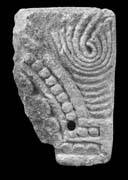
Object type: Part of the head of a decorated opening
Measurements: H. 47.8 cm (18.8 in); W. 30.8 cm (12.1 in); D. 23.3 cm (9.2 in)
Stone type: Greyish orange (10YR 7/2) clast supported shelly muddy limestone with shell debris mainly 2 to 3 mm in size but some up to 5 mm. Possibly Ardley Member, White Limestone Formation, Great Oolite Group, Middle Jurassic.
Plate numbers in printed volume: Ills. 321-3; Fig. 20D
Corpus volume reference: Vol 10 p. 217
(There may be more views or larger images available for this item. Click on the thumbnail image to view.)
Part of a rectangular block on which is carved a semi-circular arch, decorated with a scalloped border within a curving band of pelleting enclosed between and separated by plain mouldings. The triangular spandrel above and to the right of the arch carries a great swirl of foliate decoration with individual lobes of the terminal leaf-tips separated by fine drilled holes. A hole c. 2.8 cm (1.1 in) in diameter is drilled down at an angle from the carved face to join a similarly sized hole drilled vertically up through the base of the stone. This was presumably for pouring lead into a fixing joint. A rebate, cut into the lower right corner of the carved face, may be the result of later reuse; alternatively it could be the seating for a lintel or frame. The arch spanned an opening c. 55 cm (21.6 in) wide.
The width of this decorated arch, spanning an opening half a metre wide, might suggest that it was a window-head similar to Gloucester St Oswald 17 (Ills. 324–5). However, the decoration suggests that it could instead have been part of an ornate monolithic head-block from an opening, canopy, reredos or screen. Some of the elements used in the design can be paralleled elsewhere. The pelleting is common over a long period of Anglo-Saxon and later Romanesque decoration. The combination of a scalloped border and pelleting is found around the central boss on the cross-head dated to the first half of the ninth century from Irton, Cumberland (Bailey and Cramp 1988, 116, ill. 357), and pelleting and stiff-leafed acanthus occurs on a tenth-century impost fragment from Avebury, Wiltshire (Cramp 2006, 201, ill. 396). While the swirl of densely-packed foliage filling the spandrel has some similarity with the two early to mid tenth-century acanthine frieze fragments from the site (see St Oswald 13 and 14, Ills. 313–15), the composition is unique in the Anglo-Saxon corpus and may reflect motifs used in contemporary wall painting or the architectural frames of illuminated manuscripts such as the mid tenth-century frontispiece to the De Laude Crucis (Cambridge, Trinity College MS B.16.3: Temple 1976, 42–3, cat. 14, ill. 48). The three semi-circular arches that frame the scene rise from acanthus palmette capitals, and foliate ornament fills the spandrels. In the absence of distinctive parallels the possibility that the motif is a skeuomorph of swagged curtains might be considered.
No. 16 can probably be dated to the early to mid tenth century on stylistic grounds, although a date as late as the mid twelfth century is not impossible. At St Oswald's the rebuilding associated with Period II provides a possible original context for this piece, as it does for the fragments of 'acanthus' palmette (St Oswald 13 and 14).
