Select a site alphabetically from the choices shown in the box below. Alternatively, browse sculptural examples using the Forward/Back buttons.
Chapters for this volume, along with copies of original in-text images, are available here.


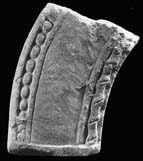
Object type: Part of decorated window(?) head
Measurements: H. 34.5 cm (13.6 in); W. 20.5 cm (8 in); D. 22.1 cm (8.7 in)
Stone type: Yellowish grey (5Y 8/1) grain supported muddy oolite with sparse shell debris, mainly bivalve fragments. Ooliths range in size from 0.2 to 1 mm and the shell debris from 2 to 3 mm. Cleeve Cloud Member, Birdlip Limestone Formation, Inferior Oolite Group, Middle Jurassic.
Plate numbers in printed volume: Ills. 324-5; Fig. 20C
Corpus volume reference: Vol 10 p. 217-8
(There may be more views or larger images available for this item. Click on the thumbnail image to view.)
Curving fragment from a stilted arch. The outer edge of the front face of this stone is decorated with a continuous row of oval pelleting bounded by a simple roll, and on the inner edge by a flat cable also bounded by a simple roll. None of the other faces on the stone are decorated. The stilted nature of the arch makes it difficult to gauge the width of the opening, but this could not have been much more than 50 cm (19.7 in). There is a circular fixing-hole in the base.
This decorated stone from the head of an opening had already been reused by the later tenth century (Period III). It carries no splay but it is probably a window-head as it is 50 cm (19.7 in) wide or less, which seems too narrow for a door. The two surviving high-level windows in the Period 1 north wall of the nave of St Oswald's have external widths of 60 and 50 cm (23.6 and 19.7 in) (Bryant and Heighway 1999, 54–62, figs. 2.11, 2.12, 2.13). Though the windows are splayed, the outer frames are not, so it is possible that St Oswald 17 formed the head of a similar window.
