Select a site alphabetically from the choices shown in the box below. Alternatively, browse sculptural examples using the Forward/Back buttons.
Chapters for this volume, along with copies of original in-text images, are available here.


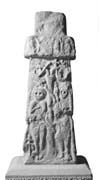
Object type: Cross-shaft
Measurements:
H. 122 cm (48 in);
W. (face A) 42 > 24.5 cm (16.6 > 9.6 in); (face C) 39 > 24 cm (15.3 > 9.4 in);
D. (face B) 25 > 14 cm (9.8 > 5.5 in); (face D) 24 > 13 cm (9.4 > 5.1 in)
Projecting collar (82 cm (32.2 in) above the present base):
H. 17 cm (6.7 in);
W. (face A) 39.5 cm (15.5 in); (face B) 23.5 cm (9.2 in); (face C) 39 cm (15.3 in); (face D) 20.5 cm (8 in)
Tenon (now set in the present base) estimated to be 23 cm (9 in) long.
Stone type: Medium yellowish orange matrix supported bio-oosparite with central 10 cm band of oobiosparite. Ooliths are mainly hollow and range in the main body of the rock from 0.3 to 1.2 mm in size and in the oobiosparite band up to 1.0 mm. Shell debris mainly up to 5 mm but some 10 mm. Bedding parallel to shaft. Possibly Taynton Limestone Formation, Great Oolite Group, Middle Jurassic.
Plate numbers in printed volume: Ills. 392-400; Figs. 24G-H, 27R, 33G-J
Corpus volume reference: Vol 10 p. 232-6
(There may be more views or larger images available for this item. Click on the thumbnail image to view.)
The cross-shaft was discovered in an upright position during landscaping works in the churchyard in the early part of April 1907. Previously the upper part of the stone had projected above ground by an amount variously given as 12 to18 inches; this upper part of the stone had traditionally been thought to mark the spot where the spire of the church fell in 1673 (Conder 1905–7, 478; Allen 1907, 197). The Parish Magazine for May 1907 describes the findspot as 'inside the Churchyard railings opposite St Michael's' (Gloucestershire Archives, P225 VE 3/2); St Michael's must mean St Michael's Cottage, 33 Church Street, Newent (on the opposite side of the road from the south side of the churchyard). The photographs published at the time of the discovery show clearly that the shaft had a tenon at the bottom; this is now concealed by the present base in which the shaft is set. The total length of the piece inclusive of the tenon is given as 4 ft 9 in (145 cm). The part of the shaft above the collar was also considered to be a tenon at the time of the discovery. The fact that the shaft was discovered in an upright position suggests the possibility that it was in fact in situ at the time of discovery and had become buried by a build-up of ground; there is indeed still a considerable build-up of ground level on the south side of the churchyard. No reference is made in the accounts of the discovery to the presence or absence of a base; it may well be that the base was unnoticed during the retrieval of the shaft and that it still remains in situ. If the shaft was indeed in situ, then it stood in a prominent position on the south side of the churchyard adjacent to the main road through Newent.
Collared cross-shaft. The edges of the shaft were originally carved with a large roll moulding, but this has been extensively damaged and in many places lost altogether. None of the carving on the shaft above the collar has survived.
A (broad): The main panel below the collar carries a carving of Adam and Eve with the serpent woven around the Tree of the Knowledge of Good and Evil (but see the discussion below). Adam and Eve have large drilled eyes and stand facing straight ahead. Adam's head is rounded with a broad nose and a crown of hair. He is also probably bearded. Eve's head is egg-shaped and she does not seem to have any hair, unless it is swept back off her face completely. Adam holds his clenched right fist across his chest, while in his lowered left hand he holds something that is clearly not a fig leaf, but seems instead to be a right-angled, long-handled implement of some kind. Eve's right fist is raised and she seems to be striking at the snake with a long narrow rod, the lower end of which passes across her chest. Her left arm is bent across below her breasts and there is an engraved V-shaped line that looks like the neckline of a garment across the base of her neck. The legs of both figures are badly eroded, but Eve's legs widen sharply above the knees as though she is wearing a skirt. In front of Eve, and partly overlapping her upper body, is a strange interlaced device that consists of four opposed pointed loops — long and narrow in the vertical dimension and short and rounder in the horizontal. These might be a spray of foliage held by Eve in her left hand, but they actually look more like flames. Below Adam's feet are rounded stones and beside his right foot a small plant grows from a little stepped platform. The plant has a vertical stem, drooping side leaves and a lobed tip. Eve's feet seem to be tangled in foliage but the area is badly damaged. The central tree grows straight up between Adam and Eve, with no side shoots and a ridged, cup-shaped node at the top. From this cup two side branches twist outwards before splitting again at further cup-shaped nodes and weaving over and under the main branches. A small, vertical cross terminates one of the smaller branches on the right side, and, on the left, a subsidiary branch curves downwards above Adam's head before ending in a trefoil of large leaves.
On face A the collar has four figures below a row of round-headed arcading, with hollowed-out spandrels between the arches. The figure on the extreme right is a man wearing a long garment, and the next figure might a person in profile or possibly a bird. Of the remaining two, one has gone completely and the other is too worn to be able to decipher any details.
B (narrow): The main image is that of David and Goliath. The faces of both figures are oval with large drilled eyes like Adam and Eve. David's hair is long and curly. Even though Goliath is collapsing to the right, his height is such that he covers nearly three-quarters of the frame. In his right hand he is still holding his enormous spear, the shaft of which runs diagonally across the image from bottom right to top left, and his head has fallen forward onto his raised left hand. He wears skirted armour and a wide belt. His trousered legs and booted feet are twisted as he begins to fall. David appears above and behind Goliath, in the act of cutting off the giant's head with a downward-pointing sword. One of David's hands is clearly shown above the sword's crossguard, while above the hand is what may be a large angular pommel or perhaps David's other hand.
The collar on face B was originally divided into three panels by narrow vertical borders. Little of the right-hand panel survives and the fragmentary remains of the image in the left-hand panel is not decipherable. The central section, however, carries a half-length figure with a long, narrow head and drilled eyes. In-curving upraised wings flank the figure's head, while the figure's left arm is bent up at the elbow and the left hand grips the upper end of a narrow shaft that runs diagonally across the body. The figure's right hand grips the lower end of this shaft, and it seems reasonable to suggest that the figure is holding a spear.
C (broad): This face is heavily damaged. In the upper left there is a large figure wearing a long heavily pleated or folded garment, the sleeve of which has been caught into twisted folds. The figure's head is broad, with a pointed chin, a small pursed mouth, a short nose, wide-spaced, rather sunken but not drilled eyes, and small round ears. The figure seems to be wearing a keffiyeh-style headdress, with what might be a jewelled setting at the centre of the forehead and long side pieces that fall across both shoulders. The figure's right arm is held across his chest holding what looks like a flaming torch, while his left hand is raised and points to the upper right corner of the frame. Immediately below this figure there is a second smaller figure leaning over the top of a vertical pillar and standing on a box-like object that is covered with rows of small squares. There are fragmentary remains of a third figure to the right of and slightly below the first figure. All details of the head of this third figure have disappeared, but the surviving outline seems to indicate that the figure is looking up towards the upper figure. Heavy sagging folds betray the elbow and right arm raised towards the upper figure, while the left arm and hand point directly down towards a creature, a ram, caught in a tangle of interlace. There is a circular disc behind the ram's head that may be his horns. The central pillar is square sided and rises from a triple-stepped circular base.
None of the carving on the collar survives on this side, which is flush with the face of the cross-shaft.
D (narrow): The main part of the shaft consists of three panels divided by simple horizontal mouldings. (i) In the uppermost panel there is a long-necked, four-legged creature enmeshed in a tangle of interlace. The creature's head is bowed forward, with a long snout, large drilled eyes and big ears with slightly hollowed-out centres. There are incised eyebrow or forehead lines above the eyes, and the nostrils are sketched in. The feet are hoofed. This graceful creature seems to be a deer. (ii) In the panel below this creature there is a pair of outward-facing birds, either side of a slender central plant stem that ends at the top in a cupped node. From the cup two twisting tendrils spring up on either side of a small, rounded terminal bud. The bird on the left is badly damaged, but enough of the one on the right survives to show that the bird seems to be preening its wing feathers with its beak. (iii) The lowest panel on this face contains a tree-scroll rising from a stepped base. The two side branches are simply looped across themselves in gentle sweeps, and end in rounded fruits. The central stem swells towards the top, but no surface detail survives that might help establish what this feature was.
The collar on face D is badly weathered but carries what might be a central figure with a round head and a body that consists of two slightly raised squares joined by a narrower raised section. Alternatively, this feature may be the divider between two almost totally degraded figures. Above the collar there is an area of raised stone that betrays the last vestiges of carving, but it is too heavily weathered to show any detail.
The Newent 1 cross-shaft is a very rare survival in Gloucestershire west of the Severn. It seems likely that the cross always stood where it was found, beside the main road through this little market town (see Evidence for Discovery). It is one of a distinctive but uncommon group of ninth- and tenth-century collared shafts, most of which have been found in north and east England (for example, at Nunnykirk, Northumberland (ninth century), Middleton, eastern Yorkshire (tenth century), and Creeton, Lincolnshire (later tenth century) (Cramp 1984, 214–15, pls. 208–9; Lang 1991, 184–5, ills. 682–5; Everson and Stocker 1999, 139–40, ills. 124–7). In western Mercia, several fragments now built into the wall of St Andrew's church in Wroxeter, Shropshire, are known to have been parts of a collared cross-shaft taken down in the eighteenth century (see Wroxeter St Andrew 1–3, pp. 314–7, Ills. 562–9, 792–3). Collared shafts are almost certainly based upon wooden, jointed prototypes, and, therefore, give us some idea of what has been lost with the disappearance of virtually all Anglo-Saxon wood carving. But the head and upper portion of the Newent shaft have been lost and no carving survives on the remaining section of shaft above the collar.
The main panel on face A of the cross shows Adam and Eve (Ills. 392, 398), and there is enough surviving detail to indicate that they have not been caught in the act of eating the apple or covering their nakedness, but after their expulsion from Eden. Adam carries an implement of some kind with a long handle and a second narrow element (perhaps a blade) that is set at right-angles to the handle. This could be an axe, but looks more like a 'dutch' hoe or a small ard. Beside his right foot a small plant grows from a carefully prepared raised bed. Eve is clearly wearing a dress, with a V-shaped neckline and a knee-length skirt, and her hand is raised to strike at the serpent above her with a stick. If Eve's body is slightly twisted to strike the snake, then the strange looped device that seems to lie partly across her chest may instead be beside or even just behind her. It can best be interpreted as the flames of the cherubim's sword that God set to guard the way behind Adam and Eve, which would mean that the central tree is representing not just the Tree of the Knowledge of Good and Evil but also the Tree of Life. This is reinforced by the fact that from the topmost branches of the tree grows a small cross, a sign that the Fall is not to be the end of mankind's relationship with God. New life and a new beginning will ultimately come through the Cross of Christ. It seems reasonable to suggest that originally there would have been a crucifixion above the collar on this face of the cross. This, and the possibility that one of the four figures on the collar above Adam and Eve might be a bird (Ill. 394), would support a proposal that these could be the gospel writers — Matthew, Mark, Luke and John — perhaps in symbol form.
Face B shows the victory of David over Goliath (Ills. 393, 399), while the figure on the collar appears to be an armed angel, most probably the Archangel Michael (Ill. 397). This face therefore depicts the man ordained by God to lead his chosen people, and from whose descendants would ultimately come the Messiah. On the Newent shaft David is portrayed as a youth but also as the epitome of the warrior, under the protection of Archangel Michael and the heavenly host. The missing upper panel might have completed the portrayal by depicting the anointing of David by Samuel, or it could have shown a linked image, perhaps that of Christ the King. David was a popular subject for early medieval carvers and manuscript illuminators (Henderson 1986), and the defeat of Goliath is one of many aspects of his life chosen for depiction. An eighth- or ninth-century Insular manuscript example can be found on the flyleaf (fol. 1) of Paulinus of Nola's Carmina in St Petersburg, National Library of Russia, Cod. Q. v. XIV.1 (Alexander 1978, 65–6, cat. 42, ill. 179).
Face C seems to continue the theme of the journey from the Fall to the new redemption, for, in spite of the damage to this face, it is almost certain that the main panel (Ill. 395) depicts Abraham and the Sacrifice of Isaac, as suggested by Condor (1905–7) and by Rosemary Cramp (Cramp 1977, 225). The upper figure is dressed in long, flowing robes and an elaborate head-dress. He holds a burning torch and points to the heavens. Below him a smaller figure is bent across what is probably a tall stone altar with his feet upon the top of a pile of wood — the wood for the burnt offering. On the north face of the North Cross at Sandbach (Cheshire) there is a figure in exactly the same pose, bent over the top of a ladder or Tree of Life. Jane Hawkes has interpreted this figure as Christ leaning over to receive the faithful as they ascend to heaven (Hawkes 2002, 72–5, fig. 2.16). To the right of the altar, slightly below the figure of Abraham, stands the Angel of God twisting to look upwards while holding up his right hand to restrain Abraham. With his left hand the angel points down towards a ram that is caught in a thicket of interlace. The ram itself has a disc behind, but not attached to, its head, which might be the ram's horns but might also be a halo. Abraham's willingness to show his faithfulness to God by sacrificing his only son Isaac is frequently used to prefigure God's willingness to sacrifice his only Son, Jesus Christ, for the redemption of mankind. If the circle behind the ram's head is a halo, then the carver may have been attempting to visualise this link by making a double use of the creature as both the sacrificial ram and as the Agnus Dei, the Lamb of God, a motif that appears in Anglo-Saxon stone carving as early as the eighth century on the Ruthwell cross (Cassidy 1992, pls. 20–2; Howlett 1992, 75–6). The use of the 'bent-figure' image for Isaac, which is so similar to the broadly contemporary image of Christ at Sandbach (see above) could be another example. Perhaps in this instance both carvers were drawing on a now lost common source. If these are attempts to encapsulate a double level of meaning in the carved image, then they would be very similar to the introduction of the cross into the Adam and Eve panel (Ill. 398).
Face D (Ills. 396, 400) seems to move away from Biblical scenes, but may in fact offer a representation of the riches of creation that God placed in the Garden of Eden and over which Adam was given dominion. Here is a tree bearing fruit, birds of the air and a wild animal. This panel, therefore, logically precedes the Adam and Eve panel, and also completes the cycle of images by offering a renewed vision of God's creation that will come with the Kingdom.
There are various elements of the carving on this cross that are distinctive features of carvings of the eighth and ninth century in Mercia.
The deeply-drilled eyes and oval or egg-shaped heads (Ills. 398–9) can be found at Breedon-on-the-Hill (Leicestershire) and Castor (Huntingdonshire) (Cramp 1977, 191–233), on the Hedda Stone from Peterborough Cathedral (Northamptonshire) (Campbell et al. 1982, 110, fig. 103), and on the Lechmere Stone in Worcestershire (see Hanley Castle 1, p. 357, Ills. 635, 637, 643). A rather differently-treated late eighth- to early ninth-century carving from Gloucester still has deeply drilled eyes, and the remains of the face are rather egg-shaped with curving cheeks and a smooth, slightly pointed chin (Gloucester Tanners' Hall 1, p. 225, Ills. 367, 370).
The plant at Adam's feet is somewhat similar to the plant at the feet of the Breedon Angel (Cramp 1977, fig. 58c), and even more similar to the plants on the back and sides of the Lechmere Stone (Ills. 638–41), and the plant-scroll with lobed leaves around the Deerhurst font (Deerhurst St Mary 3, Ills. 134, 137).
The long-necked deer on face D (Ills. 396, 400) not only has deeply drilled eyes but what Kendrick called the 'emaciated sinuosity often seen in the early ninth century' (Kendrick 1938, 182). It is very similar to a creature from the shaft of a ninth-century collared cross-shaft from St Andrew's, Wroxeter in Shropshire (see above; Ills. 562–4), which in turn is closely related to early to mid ninth-century animals on cross-shafts from Gloucester St Oswald's and Acton Beauchamp (Herefordshire) and a cross-head from Cropthorne (Worcestershire) (this volume, pp. 209, 281, 353). At Cropthorne and Acton Beauchamp these animals have deeply drilled eyes (Ills. 498, 501, 629–33), while on Gloucester St Oswald 4 there is a creature with long, rather spindly legs very similar to the Newent animal (Ills. 289, 291). Similar creatures can be found on the Ormside bowl that is dated to the second half of the eighth century (Webster and Backhouse 1991, 172–3, cat. 134 and ill.).
In manuscripts, oval faces with large eyes, and heavily folded garments, are to be found in figure paintings, for example two images of David from the eighth-century Durham Cathedral Cassiodorus (Alexander 1978, 46, cat. 17, ills. 74, 75), and the image of St Luke from the Book of Cerne that is dated to the first half of the ninth century (Brown 1996, pl. 1a).
All the above points to a date for the Newent shaft in the late eighth and ninth centuries, and most probably to the first half of the ninth century.
Unlike most of the sites in Gloucestershire with sculpture, Newent lay in that part of the county (west of the rivers Severn and Leadon) which was in the medieval diocese of Hereford. There is no pre-Conquest historical evidence, but Newent had a very large parish with dependant chapelries (Ju?ica 2010, 7–8, 84–6, 298, 341); it seems likely that Newent was a minster church.
