Select a site alphabetically from the choices shown in the box below. Alternatively, browse sculptural examples using the Forward/Back buttons.
Chapters for this volume, along with copies of original in-text images, are available here.


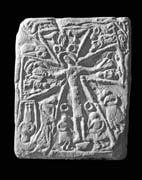
Object type: Memorial tablet
Measurements: H. 20.3 cm (8 in); W. 16.5 cm (6.5 in); D. 3.2 cm (1.3 in)
Stone type: Pale greenish yellow (10Y 8/2) to pale olive (10Y 6/2) Fine to very fine-grained (0.125 to 0.2 mm) sandstone. Poorly sorted with possibly some silt content. Mainly quartz grains but mineralogy indistinct perhaps due to some paint residue. Possibly a Lower Palaeozoic sandstone ?Silurian. ?Downton Castle Sandstone Formation, Downton Group, Silurian.
Plate numbers in printed volume: Ills. 401-12; Figs. 31F, 32G
Corpus volume reference: Vol 10 p. 236-9
(There may be more views or larger images available for this item. Click on the thumbnail image to view.)
Discovered whilst digging the foundations for new vestries at the north-west corner of the nave. The tablet 'was found five feet below the surface of the graveyard and in conjunction with the remains of two bodies, the skull of one resting on the tablet, which may have been placed as a cushion (?). The body lay east and west, the head to the west' (Conder 1911–12). The discovery was made beneath the priest's vestry (the eastern half of the new vestries), and the discovery took place shortly before May 14th, 1912 (Gloucestershire Archives, P225 IN 4/5 & P225 VE 3/2).
Small rectangular stone tablet. The stone is carved not only on both faces but also on all four edges. It has been called a pillow-stone, and was certainly found in a burial under the skull (see above). Zarnecki described the tablet as 'overcrowded with figural representions which are iconographically unconventional and executed in a naive style which makes explanation of the subjects difficult' (Zarnecki 1953b, 49).
A (broad): This face is carved with a Crucifixion scene. The cross is a B6 type with wedge-shaped arms and shaft, outlined with a narrow roll moulding. On the cross-head there are two raised circles, and there are two more on the cross-shaft, one on either side of Christ's body. Zarnecki suggested that these are probably skeuomorphic rivet holes that would be required to fix a metal or ivory panel onto the cover boards of a book (Zarnecki 1953b, 52; but see Thompson 2004 below where the idea is taken to its logical conclusion). The exaggerated shape of the elements of the cross serves to focus the eye onto the head and chest of the figure of Christ. He is long and thin with a small head leaning to one side, and large hands. A rather straight-sided nimbus encircles Christ's head, and his feet rest on a plinth or suppedaneum. Above the head of Christ the Hand of God, superimposed across the top of the cross, emerges from clouds. On either side of the Hand, within the outline of the cross-head, are what seem to be two birds. Beside Christ's feet, also within the outline of the cross, stand two figures (probably men) wearing short tunics and caught in movement. To the left and right of these figures, but outside the edging frame of the cross, stand two larger figures. One, a woman, is wearing a long dress, wringing her hands and looking down. The other, probably a man, is wearing a shorter garment and is looking up with one hand raised. To the woman's right, on the left side of the tablet, there is a figure in a coffin. The figure is carved with head pointing downwards and the feet almost touching one of the arms of the cross. Above the cross-arm on the left side is what is probably an angel, hands clasped in prayer. Above the cross-arm on the right side of the tablet is a crowded scene with three figures carved at 90 degrees to the main axis of the design. One figure is standing behind a kneeling figure who is raising his arms in front of the third figure, that of a woman who is perhaps holding a baby. This is probably a Nativity scene as suggested by Coatsworth (Coatsworth 1988, 180). Beside this scene (this time on the main axis of the tablet) stands a small figure, with hands clasped, in front of an angled, sword-shaped object perhaps being held by a figure in the extreme top right-hand corner. Coatsworth described this area of the design as a plant form, but if it is a sword then it could be the cherubim guarding the way to the Tree of Life. Whichever is correct, this seems to be a representation of the Fall with Adam leaving Eden. Within the expanded ends of the cross-arms, above and below Christ's hands, there are more little figures. The figure above on the left is a kneeling angel, while the figure on the right, also possibly an angel, is actually draped over Christ's hand and reaching down towards the figure below. Both of the figures below Christ's hands are carved at 90 degrees to the cross. The one on the left may also be winged and is depicted in action, pushing down with a long-shafted cross or a rod with a three-pronged end. The figure on the right is more passive, standing (or lying) with curving arms and holding a narrow vertical object in clasped hands. Coatsworth suggested that this last figure is holding a circular object and this interpretation is more apparent under oblique lighting from the top of the panel.
C (broad): The opposite face is carved with a scene dominated by a figure in priestly garments and with a pectoral cross on his breast. The figure has an oval head and the merest sketch of a face with a straight, slightly angled nose. He holds a crosier or shepherd's crook in his right hand, and in his left a long-shafted cross with a rather strange head that consists of a trapezoidal frame around an equal-armed cross. This is probably intended to be a representation of a ring-headed cross. In the upper right-hand corner of the tablet there is a hunched figure who may have small wings and who may, therefore, be an angel. Coatsworth suggests that this figure is veiling his face and Zarnecki thinks that the 'wings' might be a second figure (Coatsworth 1988, 180, Zarnecki 1953b, 53). Below this figure, four more tumble down across the stone to be trampled under the feet of the central figure. In the lower left-hand corner stands a figure with a shield and a large, upraised sword, while above two smaller figures rise up towards the top of the stone. Across the top lies a figure with the name Edred carved in raised letters above it. The figure's feet are to the left, the right hand reaches out to touch the cross and the head rests on the top of the central figure's head.
B, D, E, F (narrow): All four edges of the stone carry raised inscriptions (see below) consisting of the names of the Gospel writers — Matheus, Marcus, Lucas and Iohannes — plus the name Edred repeated from face C. Each name is divided from the next by a small cross. Two small incised letters — F E — between the Edred name and the dividing cross that precedes Matheus seem to be secondary.
Inscriptions Face C contains the text EDRED in the script known as Anglo-Saxon capitals and in relief lettering. The text is set at the top of the stone (Ill. 404). EDRED is the Anglo-Saxon male personal name Eadred, but it is uncertain whether this refers to the prone figure beneath or to one of the other figures carved on the stone, or to someone else entirely. The way that the letters are fitted in around the carving might suggest that this text is not primary so much as an after-thought; alternatively, and more likely in view of the relief lettering, it may simply indicate insufficient planning on the part of the sculptor.
Faces B, D, E, and F, the edges of the stone, contain further text consisting of the names of the Evangelists and the same Anglo-Saxon name EDRED. These texts are again in Anglo-Saxon capitals and relief lettering (Ills. 409–12). They read continuously anti-clockwise around the edges of the stone, with the letters set facing towards face C and the words divided by small crosses. Face B reads D+MATHEUS; face E reads +MARCVS; face D reads +LVCAS+IO[..]; face F reads NNES+EDRE. The text on face B begins in the middle of a word with the final D of EDRED. This suggests that the text on either face E or face D, both of which commence with a cross, should be taken as the start of the continuous text. The script is entirely compatible with the tenth- to eleventh-century date suggested for the stone on art-historical grounds.
This complex object has attracted valuable comments and analysis especially from Zarnecki (1953b), Coatsworth (1988, 180–1, 191) and Thompson (2004, 88–91). Face A (Ills. 401–2) is clearly a Crucifixion scene, although details of interpretation differ. Christ is dying, his head beginning to sag to one side. Above his head is the Hand of God flanked by two birds. The pair of birds are probably intended to represent the Holy Spirit, duplicated for symmetry, although Coatsworth suggests that they could also represent the souls of the faithful departed. Either side of Christ's feet, within the frame of the cross, are two small figures who Zarnecki interprets, with the support of parallels, as Stephaton and Longinus. These are in turn flanked by two taller, clearly grieving figures, a woman with her hands touching the edge of the cross and a man holding a book. Zarnecki identifies these as the Virgin Mary and St John the Evangelist. Coatsworth again offers an alternative interpretation, suggesting that both pairs of figures could represent Mary and John, or that one or the other of these pairs of figures might be donors. This seems to over-complexify an already complex image, and the present author suggests that the Stephaton and Longinus plus Mary and John interpretation is the more probable. In the bottom left of the image, the figure in a coffin or sarcophagus might be Edred himself but is more probably Adam, who, 'as the father of mankind, is often seen in a grave below crucifixion scenes' (Zarnecki 1953b, 50). Coatsworth linked this image with that of Adam leaving Eden, the tiny frontal figure in the diagonally opposite upper right corner. To the left of this image of the Fall, and enclosed within the arms of the cross, is a crowded Nativity scene, symbolising the beginning of the redemption of Adam and mankind that will be completed by Christ on the cross. The figures immediately above and below Christ's hands could be angels with the Instruments of the Passion (Coatsworth). Alternatively the figure on the left below the crucified Christ's hand, bent forward and beating down with the cross or rod in his hands, might be Christ at the Harrowing of Hell (Zarnecki), with the other figures being angels praying or helping up a freed soul.
Face C (Ills. 403–4) has been interpreted as the Last Judgment (Zarnecki; Thompson), as the Harrowing of Hell (Coatsworth) or as a Celtic bishop (Bradfield 1999). However, in spite of the ecclesiastical nature of his garments, this last is very unlikely. The central figure should be seen as Christ, and the rest of the iconography reinforces this interpretation. The presence of the armed figure, presumably St Michael, standing with drawn sword to the left of the central figure, and effectively dividing those figures who are being trampled underfoot from those who are rising upwards, would tend to support the view that this is a Last Judgment scene. At the top of the stone, on the left among the elect, lies Edred with his hand clutching the Cross of Salvation and his head resting on his Saviour. In the right upper corner, opposite to Edred and diagonally opposite to St Michael, is a figure who may be winged and who seems to be shielding his face from Christ's glory, cowed but not falling with the damned. Perhaps this is Satan, the rebel angel.
Victoria Thompson has drawn together these two complex images, the skeuomorphic rivet holes on the representation of the Crucifixion, and the inscribed names of the Gospel writers around the edge of the stone, to make a well-argued proposal that the Newent 2 slab should be seen not as a pillow-stone or a memorial tablet but as a stone rendition of a gospel-book (Thompson 2004, 88–91). She sees the 'ornate plaques of the Crucifixion and the Last Judgement fastened to front and back covers' (like metal or ivory examples on real books) 'and the contents represented by the names of the Evangelists carved around the narrow sides'. The 'book' was then personalised with Edred's name and presumably buried with him. 'Here, surely, we have a Christian grave-good for use in another life, a very personal object and one of great sophistication' (Thompson 2004, 90). The raised letters of the inscriptions on this object are, like the front and back panels, reminiscent of repousée metalwork or ivory exemplars.
The iconography includes the coming of Christ and his death on the cross that opens the way to redemption for the fallen Adam and for mankind; Creation (if the entombed figure below the cross is Adam) and new beginnings with the renewal of the Covenant through the sharing of the Good News of the Gospel; the Last Judgement and the raising to perpetual glory of the elect; and probably the Harrowing of Hell and the defeat of Death and Evil. There is also an affirmation of Trinitarian Doctrine in the Hand of God and the representation of the Holy Spirit. Thompson shows that all of these aspects are intimately linked with the various stages of a late Anglo-Saxon funeral rite preserved in Oxford, Bodleian Library, MS Laud Miscellaneous 482 (Thompson 2004, 90–1), a manuscript with a probable Worcester provenance (ibid., 67).
This small tablet has been dated by means of various parallels and with perhaps surprising consistency, with the exception of Bradfield's untenable early eighth-century proposal (Bradfield 1999). Thompson's comparison with the late Anglo-Saxon funeral rite in Laud 482 supports an eleventh-century date. Laud 482 is normally dated to the middle or second half of the eleventh century (Gneuss 2001, no. 656). The lettering was said by Francis Wormald to be eleventh century (Zarnecki 1953b, 53), while Zarnecki himself suggested a similar date on art-historical grounds (ibid., 52). The shape of the cross in the Crucifixion image is similar to a late tenth-/early eleventh-century walrus ivory pectoral cross now in Copenhagen (Beckwith 1972, 125–6, cat. 36, ill. 73). Zarnecki draws a parallel with another walrus ivory cross (found in Lewes and now in the British Museum) where the shape of the cross is similar, if less exaggerated, and on which Christ appears as a long narrow figure with his feet on a supporting block, a horseshoe-shaped halo resting on his shoulders, and the Hand of God across the top arm of the cross (Zarnecki 1953, 52, pl. VIIb). This small cross also has rivet holes for fixing it to an object such as a book cover and has been dated to the late tenth/early eleventh century, or to the first half of the eleventh century (Beckwith 1972, 125, cat. 35, ill. 70; Backhouse et al. 1984, 124–5, cat. 128, illus.). Coatsworth drew upon the association of the Fall with the Crucifixion in art and in late Old English homiletic literature to support the late tenth- to early eleventh-century date suggested on epigraphic grounds by Elisabeth Okasha (Coatsworth 1988, 181; Okasha 1971, 102–3; and see above). A date for the Newent 2 stone in the eleventh century is, therefore, reasonably certain, and taken as a whole the evidence would tend to suggest the first half of the eleventh century.
