Select a site alphabetically from the choices shown in the box below. Alternatively, browse sculptural examples using the Forward/Back buttons.
Chapters for this volume, along with copies of original in-text images, are available here.


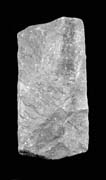
Object type: Part of cross-shaft
Measurements: H. 30 cm (11.8 in); W. 50 > 36 cm (19.7 > 14.2 in); D. 24 cm (9.4 in)
Stone type: Sandstone, hard, medium- to very coarse-grained (0.2 to 0.8 mm), very poorly sorted, sub-angular to sub-rounded grains of dominant quartz. Some feldspar and mica grains. Pale red to moderate orange pink (10R 6/2 to 10R 7/4). Bromsgrove Sandstone Formation (Helsby Sandstone Formation), Sherwood Sandstone Group, middle Triassic.
Plate numbers in printed volume: Ills. 545-7
Corpus volume reference: Vol 10 p. 307-8
(There may be more views or larger images available for this item. Click on the thumbnail image to view.)
Discovered in November 1983 by Mr Davies-Sage of Oswestry in the River Morda (here no more than a fast-flowing shallow stream) 2 km to the south-west of Oswestry. The stone was found 'carved face upwards, on the bed of the river, c. 1.5 m from the river bank and c. 10 m downstream from a stone bridge carrying the minor road known as Penylan Lane which runs from Oswestry to Coed-y-go' (Watson 1985, 109). The stone was removed from the river by Mr Davies-Sage.
Carved panel, possibly from a cross-shaft. Only one carved face now survives but it is clearly part of a larger stone. The decoration, which is about 20 cm (7.9 in) high, consists of simple, median-incised, eight-strand interlace in a dense pattern. There is at least one, and possibly two, return loops visible at the top and also probably at the bottom, suggesting that the original upper and lower borders of the carved panel were not much beyond the present edges. The interlace originally continued to the left, but it is bounded on the right by a heavier half-round moulding in the shape of a shallow, horizontal 'V'. The stone is broken beyond this point.
The undecorated face and the bottom edge of the stone have been trimmed back to form a flat surface, indicating that the stone was probably reused as building material prior to its discovery in the river (Watson 1985, 109).
Watson acknowledges that it is not possible to be certain as to whether this stone was part of an architectural carving or a free-standing cross-shaft (Watson 1985, 110), but he draws attention to the very close similarities between the interlace on the Morda stone and that on two tenth-/early eleventh-century Welsh carvings, the Maen Achwyfan cross-shaft near Whitford and a cross-shaft fragment from Rhuddlan, both in Flintshire (Nash-Williams 1950, 127–9, figs. 137–8, pl. XXXIV), and on a tenth-century cross fragment from Kirkby Wharfe, west Yorkshire (Coatsworth 2008, 187–8, ill. 438). Similar tenth-century carvings from western Mercia include the small piece from Evesham, Worcestershire (no. 1, Ill. 634) and a grave-cover from Whitchurch, Warwickshire (no. 2, Ill. 608).
Watson also comments on the unusual findspot for the stone, suggesting that it was probably laid in the river as part of a weir, built before 1790 in order to feed the race for Pen-y-Ilan Mill. The mill race's sluice gate was about 8m (26 ft) downstream from the weir. Prior to this, the stone had already been reused as building material. But before this it is perhaps significant that less that half a kilometre from the findspot is a hamlet called Llwyn-y-maen. 'The place name means "grove of stone", and the element "maen", or stone, is sometimes given to pre-Norman crosses and other early stone monuments in Wales, of which the above mentioned Maen Achwyfan cross ... is an example. It may be therefore that Llwyn-y-maen is the site of a pre-Norman free-standing cross of which the only known surviving remnant is the fragment found in the River Morda' (Watson 1985, 110). It should however be noted that many of the Welsh names of the Oswestry area are thought to be due to 'immigration of Welsh speakers in comparatively recent times' (Coates and Breeze 2000, 329–30; see also Morgan 2008, 215–16, who considers the use of the Welsh language to have expanded in this area between the twelfth and sixteenth centuries). While it is perfectly feasible to suggest that the name Llwyn-y-maen referred to a standing cross, it would seem improbable that the name is itself of early medieval origin.
