Select a site alphabetically from the choices shown in the box below. Alternatively, browse sculptural examples using the Forward/Back buttons.
Chapters for this volume, along with copies of original in-text images, are available here.


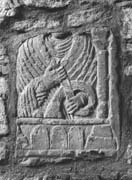
Object type: Figural panel
Measurements: H. 36 cm (14.1 in); W. 27 cm (10.6 in); D. unknown
Stone type: Greyish yellow (5Y 8/4) oolite with ?sparry matrix. Hollow ooliths mainly around 0.5 to 0.8 mm in size. Cleeve Cloud Member, Birdlip Limestone Formation, Inferior Oolite Group, Middle Jurassic. Probably from Bredon Hill.
Plate numbers in printed volume: Ills. 646-7; Fig. 34C
Corpus volume reference: Vol 10 p. 360-1
(There may be more views or larger images available for this item. Click on the thumbnail image to view.)
First noticed by King (1992, 129), who plausibly suggests that this stone may have escaped earlier attention due to it having been concealed by furnishings in modern times.
A small panel, perhaps part of a screen, on which there is a half-length figure. To the right of the figure there is a column, with a double-stepped pyramidal base and a tapering capital surmounted by a trapezoidal abacus. The remains of a similar base survive below the figure to the left indicating that there were originally columns on either side of the figure. A broad, flat, slightly damaged edge-moulding runs up the right side of the panel, across which the base intrudes in the lower right corner. Below the figure there is a plain horizontal moulding and below this, between the two bases, there are three small arches. These in turn sit on another broad plain horizontal moulding, and below this there are vestigial remains of further carving with an oblique, raggedly-broken lower edge. The head is missing but the rounded chin survives. The figure is broad shouldered and probably male, and wears an undergarment that is visible as tight, sharp-edged, folds around the neck and wrists. The outer garment, probably a chasuble, envelopes the figure and has a broad, raised 'collar' decorated with incised diagonal lines set between narrow borders. The surface of this outer garment is entirely covered with raised parallel bands. These bands seem to be partially overlapping and they are alternately hatched and plain, giving a richly textured appearance. A fold of the outer garment is wrapped across the figure's right arm, while in both hands he holds a broad, flat, strap-like object that is twisted back on itself to end in an extravagant tassel. Like the 'collar', the surface of this object is covered with incised diagonal lines between narrow borders.
James King (1992) has written a valuable analysis of the Pershore 1 panel and the following discussion draws heavily on his observations. The overall composition of the panel, assuming that there would have been an arch over the figure's head and resting on the two columns, is very similar to several carvings from the eighth or ninth centuries. Examples can be found in the Virgin panel from Breedon-on-the-Hill, Leicestershire, several panels on a cross-shaft and base from St Andrew Aukland, Co. Durham, three figures on a cross-shaft from Otley, west Yorkshire, and the figure on a grave-marker from Whitchurch, Hampshire (Cramp 1977, 210–11, fig. 58; Cramp 1984, 37–40, pls. 1–5; Coatsworth 2008, 215–19, ills. 558, 564, Tweddle et al. 1995, 271–3, ill. 483).
The sharp-edged, overlapping folds are paralleled in western Mercia by the treatment of the flight feathers on the wings of the half-length figure of an Angel or Archangel from Deerhurst (first half ninth century; see Deerhurst St Mary 4, p. 168, Ills. 145–6), and on the roundel depicting Christ from Gloucester Cathedral, which is dated in this volume to the ninth rather than the tenth century after further study of the Carolingian-inspired decorative motifs (Gloucester Cathedral 1, p. 203, Ills. 252–8). The diagonal hatching on the folds of the over-garment at Pershore can be found on the garment worn by Christ on fol. 2a of a ninth-century Irish Gospel Book (Turin, Bibl. Nazionale, Cod. O. IV. 20: Alexander 1978, 80–1, cat. 61, ill. 280), while in the late eighth- or early ninth-century Book of Kells the under-garment of Christ and the angels' wings on folio 202v are also covered with bands of diagonal hatching, as is the front of the over-garment on a small figure at the top of the initial letter of Matthew's Gospel on fol. 29r (Henry 1974, 23, 68, 104). The Carolingian link apparent on the Gloucester roundel is also evident in the use of a trapezoidal or tapering capital with a trapezoidal impost on the column beside the Pershore figure. This is a Byzantine-inspired architectural device, adopted by Carolingian master masons in churches of the eighth and early ninth centuries, for example in the Palatine Chapel at Aachen or in St Justinus at Höchst (Backes and Dölling 1969, ills. on 75, 78). In manuscript art, capitals and bases exactly like those on the Pershore panel can be found on folio 1v of the tenth-century Rabanus Maurus' De Laude Crucis (Cambridge, Trinity College, MS B.16.3: Temple 1976, 42–3, cat. 14, ill. 48). Earlier examples, with trapezoidal abacii set above 'thistle-shaped' capitals, can be found in cannon tables on fols. 2v and 3r of the Book of Kells (Henry 1974, 4, 5).
One particular feature on the Pershore panel is unusual. The strap-like object that the figure holds in both hands is damaged at the point at which it is looped up over the thumb of the right hand, but it is almost certain that it was originally carved as though it was joined onto the raised 'collar'. The link is reinforced by the similarity of surface decoration on the 'collar' and the 'strap', and this suggests that both should be seen as a single object, a stole or a pallium draped around the figure's neck. However, a stole would have two ends and the Pershore object clearly only has one, twisted around because of lack of space in the frame. The figure is, therefore, almost certainly that of a pope or an archbishop wearing a pallium.
St Andrew's church, Pershore, stands immediately east of and aligned with Pershore Abbey. In the later Middle Ages, the abbey and St Andrew's served separate parishes, but this reflects the seizure of two-thirds of Pershore abbey's estates by Edward the Confessor to endow Westminster Abbey (Bond 1988, 133, fig. 30). It seems likely that the two churches originated as part of a single minster complex, as Steven Bassett (2001, 3) has suggested. Pershore was one of the series of important minsters established on the banks of the River Avon in Worcestershire. Its origins are obscure, but it may have been founded in the late seventh century: a later charter refers to Ealdorman Beornnoth having obtained privileges for Pershore from King Coenwulf of Mercia (796–821) (Sawyer 1968, no. 786; Sims-Williams 1990, 94–6, 137, 144). In the 960s or early 970s, Benedictine monks were installed at Pershore, but as at nearby Evesham, the monastic community had a chequered history (Barrow 2004, 152–3). Recent excavations inside the abbey church have revealed foundations of a pre-Conquest church of uncertain date (Blockley 2000, 8–12).
