Select a site alphabetically from the choices shown in the box below. Alternatively, browse sculptural examples using the Forward/Back buttons.
Chapters for this volume, along with copies of original in-text images, are available here.


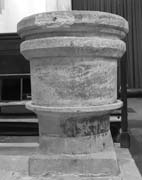
Object type: Font1
Measurements:
H. (of reused column base) 52 cm (20.4 in); W. (max. external diam.) 72 cm (28.3 in)
Font bowl: H. (internal depth) 25 cm (9.8 in); W. (internal diam.) 50 > 42 cm (19.7 > 16.5 in); Width of rim: 11 < 11.5 cm (4.3 < 4.5 in)
Stone type: Pale shell detrital oolitic limestone with minor calcite cement and a fine, but uniform, ferruginous content causing it to weather to a pinkish colour where exposed (Bagshaw 1997, 35).
Plate numbers in printed volume: Ill. 747
Corpus volume reference: Vol 10 p. 384-5
(There may be more views or larger images available for this item. Click on the thumbnail image to view.)
This font is hollowed out from what is almost certainly an upturned Roman column base. The font is now set upon a slightly smaller, collared shaft that was probably also made from sections of Roman column. The Roman base in which the font bowl has been carved has rather angular double torus mouldings. The diameter of the portion of column shaft that is integral with the base is 56.5 cm (22.2 in) where it is seated on the collar moulding at the top of the lower, smaller shaft. Bagshaw noted that the 'tooling marks are well preserved and show that a fine point or punch was used vertically as the final finishing' (Bagshaw 1997, 35). The font bowl is flat-bottomed with tapering sides and a central drain hole. The lower part of the bowl is lined with lead.
Appendix K item (Fonts and stoups in the Western Midlands).
It was Steve Bagshaw who first suggested that this font was carved from a reused Roman column base (Bagshaw 1997, 33–35, figs. 17, 18) from the nearby Roman city of Corinium Dobunnorum (Cirencester) little more than two kilometres away along Ermine Street. The base is large and must have come from a major public building. The double torus moulding is unusually angular and may have been re-cut, although Bagshaw notes that Cirencester 'boasts a particularly unusual and diverse selection of Romano-British column bases' (Bagshaw 1997, 35). Bagshaw adds that there is a second font, carved into one end of a section of fluted column (now in Latton Church, just across the county border in Wiltshire), which, together with another Roman column base, used to belong to the demolished church at Water Eaton (Bagshaw 1997, 32–3, fig. 16). As noted above, the shaft upon which the font now stands may also be Roman, but could have been added later to raise the level of the font bowl. The reuse of Roman material for fonts is also discussed in this Appendix under the entry for the Roman column base font in Shrewsbury Abbey, Shropshire (p. 389), and in Chapter V, Further thoughts on fonts (pp. 62–4).
The place-name of Preston (the priests' tun) is an indication that the village was subsidiary to the major centre of Cirencester, but the blocked remains of an Anglo-Saxon doorway still visible in the north wall of All Saints' nave show that the settlement had its own church by the later pre-Conquest period (Darvill and Gerrard 1994, 95) and a post-Conquest chapelry in the deserted village of Norcote was dependent on Preston church (Darvill and Gerrard 1994, 117).
