Select a site alphabetically from the choices shown in the box below. Alternatively, browse sculptural examples using the Forward/Back buttons.
Chapters for this volume, along with copies of original in-text images, are available here.


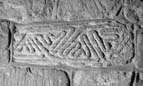
Object type: Part of cross-shaft
Measurements: H. (present width) 42 cm (16.5 in); W. 18 > 14 cm (7 > 5.5 in); D. unknown
Stone type: Greyish yellow (5Y 8/4) oolitic shelly muddy limestone, patinated probably with a paint residue. Ooliths around 0.2 mm in size with shell debris around 4 mm. Stone mainly covered in thin layer of calcareous material or ?paint. Possibly Taynton Limestone Formation, Great Oolite Group, Middle Jurassic.
Plate numbers in printed volume: Ills. 415-6
Corpus volume reference: Vol 10 p. 240-1
(There may be more views or larger images available for this item. Click on the thumbnail image to view.)
None. Noticed by Michael Hare during a visit in July 1978. The south aisle was presumably built at the same time as the fourteenth-century arcade, perhaps reusing this cross-shaft fragment as building stone; however, the church was the subject of extensive restorations in the nineteenth century (Verey and Brooks 2002, 637), and the fragment may have been built into the wall during these works.
Part of a cross-shaft covered with a large diagonal key-fret pattern in shallow relief (Allen 1903, 327, 341, nos. 870, 930). The edge mouldings are similar in width to the fret.
The key fret on this cross-shaft finds late eighth-century parallels in the county on the fragments of an impost and a hood-moulding from Berkeley (this volume Berkeley Castle 4 and Berkeley St Mary 2, Ills. 10–12, 21–4). The diagonal setting for the fret is particularly similar to that on the Berkeley hood-moulding. The pattern is also used on a late eighth-century panel fragment from Glastonbury, Somerset (no. 11: Cramp 2006, 157–8, ill. 251) and on the early ninth-century broad frieze at Breedon-on-the-Hill, Leicestershire (Cramp 1977, 194, figs. 50, 54; Jewell 1986, 102–3, pls. XLVII, LI). In manuscript art parallels can be drawn with the late eighth-century St Petersburg gospels, fol.16 (St Petersburg, National Library of Russia, Cod. F. v. I. 8: Alexander 1978, 64, cat. 39, ill. 190), and with the fret on the border across the bottom of the page which depicts King David with his musicians in the eighth-century Vespasian Psalter, fol. 30v (BL, Cotton MS Vespasian A. I: Alexander 1978, 55–6, cat. 29, ill. 146). The tapering design inside what are almost double borders, with the inner border becoming part of the fret pattern, can be seen (if rather curved) on an initial in a late eighth-century copy of Bede's Historia ecclesiastica, fol. 5v (BL, Cotton MS Tiberius C. II: Alexander 1978, 59–60, cat. 33, ill. 165).
Prestbury is mentioned in a lease of 899x904 (Sawyer 1968, no. 1283), but the status of Prestbury is unfortunately not clear. The place-name must indicate an ecclesiastical association of some sort; it is possible that Prestbury was itself a minor minster church, but it seems more likely that Prestbury took its name from possession by the priests of a minster church (Hare 2010, 146–7).
