Select a site alphabetically from the choices shown in the box below. Alternatively, browse sculptural examples using the Forward/Back buttons.
Chapters for this volume, along with copies of original in-text images, are available here.


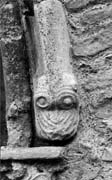
Object type: Animal-head label stop
Measurements:
Animal head: H. 15 cm (5.9 in); W. 11 cm (4.3 in); D. 9 cm (3.5 in)
Hood-moulding above head: H.18.5 cm (7.3 in); W. 11 cm (4.3 in); D. 7.5 cm (3 in)
Stone type: Greyish orange (10YR 7/4) oolite, grain supported in sparry matrix, shelly. Ooliths well sorted at around 0.5 mm and many are hollow. Shell debris 2–3 mm. Shell debris from brachiopods and bivalves. Cleeve Cloud Member, Birdlip Limestone Formation, Inferior Oolite Group, Middle Jurassic.
Plate numbers in printed volume: Ills. 648-9
Corpus volume reference: Vol 10 p. 361-2
(There may be more views or larger images available for this item. Click on the thumbnail image to view.)
None. The two beast heads Ripple 1 and 2) seem likely to have been in their present position since the west doorway was built in the first half of the thirteenth century; they were noted in their present position in 1913 (Page and Willis-Bund 1913, 493).
One of a pair of animal heads reset over the thirteenth-century west door (see also no. 2). The head is carved integrally with a section of hood-moulding that has been re-cut to match the profile of the later hood-moulding. The creature's head is fairly square with slightly rounded jaws and a sharply angled forehead. Two large circular eyes are set on the front of the forehead. The eyes are dished with concave pupils and they are surrounded by shallow, concentric grooves. These grooves are continues across the front part of the top of the head, where they join together along a centre line. This centre line becomes rather more pronounced as it continues down across the muzzle which is also covered with shallow grooves that follow the outline of the jaw. There are rounded nostrils, slightly sunken at the centre. The wide mouth is open and shows a row of teeth, pointed at the front and square towards the back. One heavily weathered ear survives on the right side of the creature's head. The other ear has been cut away. The surviving ear is rounded at the front and pointed at the back, and is laid back along the side of the head.
Animal-head label stops are widely used in the area, especially in Gloucestershire, from the ninth to the twelfth century. The Ripple creatures are quite similar to the bulbous-eyed, snarling beast head from St Oswald's, Gloucester, which is dated to the first phase of the building in the tenth century (Gloucester St Oswald 18, p. 218, Ills. 326–9). However, the profile of the St Oswald 18 animal head, like the ninth-century examples of animal heads from Deerhurst (Ills. 165–87, 191–210), shows a much smoother transition from the muzzle to the head. The more abrupt change from muzzle to head in the profile of the Ripple heads is more like the animals from Malmesbury Abbey (Zarnecki 1953a, 57, pl. 48). The Malmesbury heads are normally dated to the early twelfth century, but it is argued elsewhere in this volume (Gloucester St Oswald 27, p. 260) that these animal heads may have been reused from an earlier structure. Manuscript illustrations of animal-head terminals are many and wonderfully varied, but there are creatures with very similar profiles on folio 56 of the late tenth-century Boulogne Gospels, Biblioth?que Municipale MS 11, and on folio 18 in the late tenth- or early eleventh-century Copenhagen Gospels, Royal Library G.K.S. 10, 2? (Temple 1976, 66–7, cat. 44, ill. 150; and 69, cat. 47, ill. 152). Creatures with similar profiles can also be found on fol. 84 of the late tenth-century Gospel book, London, College of Arms MS Arundel 22 (Backhouse et al. 1984, 59, cat. 38, col. pl. VII). The present author suggests that the Ripple animal heads should be dated to the late tenth or more probably the eleventh century.
Ripple was a minster church established towards the end of the seventh century; it was probably in the hands of the bishops of Worcester by the late eighth century and remained an episcopal possession (Sims-Williams 1990, 96, 104–5, 144–6; Bassett 1998, 8; Hare 2008; Tinti 2010, 114–16, 173–5). At the time of the Domesday survey in 1086, there were two priests at Ripple holding one and a half hides (Thorn and Thorn 1982, no. 2, 31).
