Select a site alphabetically from the choices shown in the box below. Alternatively, browse sculptural examples using the Forward/Back buttons.
Chapters for this volume, along with copies of original in-text images, are available here.


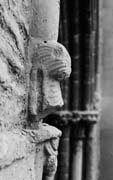
Object type: Animal-head label stop
Measurements:
Animal head: H. 17 cm (6.7 in); W. 10.7 cm (4.2 in); D. 10 cm (3.9 in)
Hood-moulding above head: H. 10.5 cm (4.1 in); W. 10.5 cm (4.1 in); D. 7.5 cm (3 in)
Stone type: As Ripple 1 above. Cleeve Cloud Member, Birdlip Limestone Formation, Inferior Oolite Group, Middle Jurassic.
Plate numbers in printed volume: Ills. 650-1
Corpus volume reference: Vol 10 p. 362-3
(There may be more views or larger images available for this item. Click on the thumbnail image to view.)
One of a pair of animal heads reset over the thirteenth-century west door (see also no. 1). The head is carved integrally with a section of hood-moulding that has been re-cut to match the profile of the later hood-moulding but now fits rather awkwardly above the label stop. The creature's head is fairly square with a sharply angled forehead. The upper jaw has been damaged, but the lower jaw survives and is squarer than no. 1. Two large circular eyes are set on the front of the forehead. The eyes are convex with a raised moulding around the outside, and they are surrounded by a series of shallow, concentric grooves. These grooves are continued across the whole of the head, where they join together along a centre line. This centre line becomes a ridge as it continues down across the muzzle which is also covered with shallow grooves that run diagonally across the muzzle. The wide mouth is slightly open to show a row of triangular teeth. There are scars for the creature's ears on either side of the top of the head. The right-hand ear scar is long pointed, and laid back along the side of the head. There are a few traces of limewash around the teeth, suggesting that this head and no. 1 were originally set inside the church.
See Ripple 1.
