Select a site alphabetically from the choices shown in the box below. Alternatively, browse sculptural examples using the Forward/Back buttons.
Chapters for this volume, along with copies of original in-text images, are available here.


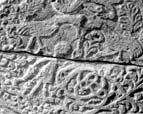
Object type: Altar pedestal?
Measurements: H. 44 cm (17.3 in); W. 60 cm (23.6 in); D. 36 cm (14.2 in)
Stone type: Greyish orange (10YR 7/4), shelly, muddy oolite, clast supported. Ooliths 0.2 to 0.8 mm. Shell debris 3–4 mm. Shells mainly brachiopods and bivalves. Some spines ?cidarid. Cleeve Cloud Member, Birdlip Limestone Formation, Inferior Oolite Group, Middle Jurassic. Probably from Bredon Hill.
Plate numbers in printed volume: Ills. 652-7; Figs. 29C, 34J
Corpus volume reference: Vol 10 p. 363-4
(There may be more views or larger images available for this item. Click on the thumbnail image to view.)
The two parts of this block were both found in June 1884 reused in the west wall of the nave, concealed by a gallery which was removed during the major restoration of 1884–5 (Chafy 1899–1900, 207; id. 1901, 119–23).
Rectangular block with surviving carving in shallow relief on two faces, the other two faces having lost their surfaces due to extensive damage. There are indications in the carving on both face A and B that a small amount of the top of the stone has been lost, but not enough to remove any sign of a socket in the top face. It therefore seems probable that there was never a socket here.
A (broad): This face depicts a small figure walking through a tangle of plant stems. The figure has a round head with a face in profile to the right. The nose is short and the mouth is a simple, slightly upturned slit. It is only possible to see one of the figure's eyes and this is large, slightly rounded in profile with an incised pupil. The back of the eye is defined by an incised horizontal 'V'-shape. The figure is wearing a short tunic. In his right hand he holds a reaping hook, while in his left hand he holds up a fruiting stem that is being pecked by two large birds. The birds have raised crests and broad tails and are probably a pair of peacocks. They have rounded, hollow-centred, feathers on their bodies and the tail feathers are hatched with close-set incised lines. Across the top of the panel there is a sinuous shape, one end of which curves back across the body to end in a three-pronged tail or perhaps a very small head with a protruding tongue. Part of this creature is missing at the top of the stone. The plants grow in lush profusion. The leaves are large and varied in shape, some being crescent-shaped and others curling or more rounded with hollowed centres. The fruiting stems seem small in comparison and may be berry bunches, although some of them look more like ears of wheat.
B (narrow): Covered by a wild swirl of broad strands of interlace which terminates in curling tips and lobed leaves. One of the shoots that spring from the centre of the leaves is pulled out into a further interlace strand. The face of the stone has lost its right edge, but the design suggests that very little of the carving has been lost.
This stone block is much too big to be part of a cross-shaft and the lack of a socket in the top makes it difficult to see how it would have functioned as a cross-base. The stone might, perhaps, have been part of a free-standing tomb, but this seems unlikely because it is not really big enough to fulfil such a role, and there are sufficient indications to show that the stone was not originally much bigger than it now is (the carved faces seem to be largely complete, so the loss of stone on the damaged faces C and D cannot have removed much more than the carved faces if indeed these faces were ever carved). Instead the stone should probably be seen as a pedestal, and the present author believes that it was part of an altar.
At first glance the subject of the front face seems similar to that of a mid twelfth-century Herefordshire School tympanum discovered in 1980 reused in the tiny, redundant church of All Saints, Billesley (Warwickshire), together with a tenth-century cross-shaft on which one face had been re-carved in the twelfth century with a dramatic Harrowing of Hell (Morris 1983; id. 1996, 8–10, figs.; see also this volume, Billesley 1, p. 335, Ills. 582–4). However, despite the similarities, the differences are also striking. On each there is a man depicted against a background of lush vegetation, in which there are birds (or a bird), a serpent and, in the case of Billesley, an exotic biped with a broad curling tail. But the Billesley man wears very distinctive wide, pleated trousers similar to a figure on the mid twelfth-century font at Eardisley, Herefordshire (Thurlby 1999, 124, 151, figs. 195, 238). He is also clearly struggling with the foliage and seems threatened by the surrounding creatures. The Rous Lench figure wears a simple tunic and he is at one with his surroundings, cutting fruiting stems from the plants with a small pruning hook and sharing them with the birds. So while the Billesley tympanum bears a fairly typical twelfth-century image of struggle, the carving on the Rous Lench stone seems to depict something much more positive — maybe Adam before the Fall (Genesis, 1: 27–31; 2: 7–15), or perhaps Christ the Harvester gathering the wheat from among the weeds and sharing the harvest with the elect (Matthew, 13: 24–30, 36–43). Both themes would seem to be appropriate to the front of an altar plinth.
The hollow-centred leaves and feathers on face A together with the variety of leaf forms rather randomly displayed would support a date in the early eleventh century for this carving, as would the rather stiff little figure and the wide, simple interlace with twists in the corners on face B.
A pension payment from Rous Lench to Fladbury would seem to indicate the likelihood that the church at Rous Lench originated as a chapelry of the minster at Fladbury (Hooke 1985, 134, fig. 33; Bond 1988, 124, 134). Fladbury itself was an important episcopal minster, one of the series of important minsters in the Avon valley (see also below under Wyre Piddle, a chapelry of Fladbury which has also produced early sculpture).
