Select a site alphabetically from the choices shown in the box below. Alternatively, browse sculptural examples using the Forward/Back buttons.
Chapters for this volume, along with copies of original in-text images, are available here.


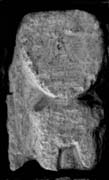
Object type: Small figure carving
Measurements: H. 19.5 cm (7.7 in); W. 12 cm (4.7 in); D. c.15 > 11 cm (5.9 > 4.3 in)
Stone type: Very pale orange (10YR 8/2), poorly sorted, matrix-supported, friable, shelly oolite. Ooliths range from 0.4 to 1.0 mm; most ooliths have weathered or fallen out to give an 'aero-chocolate' texture; they form about 40% of the rock. Ooliths are set in a sparry matrix. Elongated, platy, shell fragments up to 10 mm form about 25% of the rock. Gryphite Grit Member? Aston Limestone Formation, Lower Inferior Oolite
Plate numbers in printed volume: Ill. 479
Corpus volume reference: Vol 10 p. 264
(There may be more views or larger images available for this item. Click on the thumbnail image to view.)
Small flat-faced, relief figure, with a tiny body and large head. The facial features are lightly sketched in, with a triangular nose and straight mouth and eyebrows. The legs are apart and the stubby arms are held out to each side.
Appendix A item (stones dating from Saxo-Norman overlap period or of uncertain date).
This little rustic figure has been described as a sheila-na-gig or a fertility symbol. The reasons for this description are less obvious than in other examples. The survival of what might be a late Anglo-Saxon sundial in the south wall of this church (Saintbury 2, p. 274, Ills. 492–3) is an indication that there could have been a stone building here in which this little figure might have originally been set. It could, therefore, be Anglo-Saxon in date as suggested by Dobson (1933, 270). However, as with most such figures, it cannot be closely dated.
