Select a site alphabetically from the choices shown in the box below. Alternatively, browse sculptural examples using the Forward/Back buttons.
Chapters for this volume, along with copies of original in-text images, are available here.


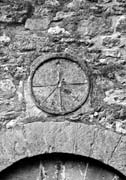
Object type: Sundial
Measurements: H. 46 cm (18.1 in); W. 48.5 cm (19.1 in); Diam. (of sundial) 44 cm (17.3 in); D. unknown
Stone type: No really clean section. Greyish orange (10YR 8/2), poorly sorted, matrix-supported, friable, shelly oolite. Ooliths range from 0.3 to 0.6 mm; most ooliths have weathered or fallen out to give an 'aero-chocolate' texture; they form about 50% of the rock. Sub-rounded shell fragments, up to 5 mm across, form about 10% of the rock. Cleeve Cloud Member? Birdlip Limestone Formation, Lower Inferior Oolite.
Plate numbers in printed volume: Ills. 492-3
Corpus volume reference: Vol 10 p. 274
(There may be more views or larger images available for this item. Click on the thumbnail image to view.)
Circular sundial divided into four quarters. The lower two quadrants are each further sub-divided into four sections. The vertical divider between these lower quadrants has a cross-bar that is almost like a sword hilt of the later medieval period. This may have been re-cut. The dividers between the second and third sections of each of the lower quadrants are similarly carved. The circular frame, the main quadrant lines and the principal dividers are all carved in relief. All other lines are incised. There is no gnomon, but the fixing point consists of two dowel holes, one above the other. The lower hole is central to the central 'boss' of the sundial. The upper hole looks like a repair or a re-enforcing in that it cuts the moulding of the central 'boss'. The dowel holes overlap and are 1.8 cm (0.7 in) in diameter. The lead? dowels are still in situ and are 0.7 cm (0.3 in) in diameter.
Appendix D item (sundials presumed to be of pre-Conquest date).
This dial is of the octaval type and could, therefore, be placed in the pre-Conquest period. The three principal division markers are similar to those on an eleventh-century circular dial from Lullington in Somerset (Cramp 2006, 194, ill. 382), and on a group of tenth-/eleventh-century circular dials from Hampshire — Corhampton, Hannington, Warnford, and Winchester St Michael (Tweddle et al. 1995, 256, 258–9, 269, 329, ills. 438, 441, 478, 671). However, the dial seems to be in situ in the twelfth-century fabric of the south wall, and, unless reused, this would seem to indicate a later date.
