Select a site alphabetically from the choices shown in the box below. Alternatively, browse sculptural examples using the Forward/Back buttons.
Chapters for this volume, along with copies of original in-text images, are available here.


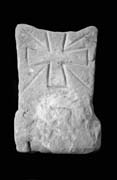
Object type: Grave-marker
Measurements: H. 56 cm (22 in); W. 37 cm (14.5 in); D. 17 cm (6.7 in)
Stone type: Moderate reddish brown (10R 5/6), friable, fairly well sorted, fine to medium-grained (0.2 to 0.5 mm) sandstone. Grains consist dominantly of quartz with some feldspar and mica. Quartz grains mainly sub-angular to sub-rounded, occasionally rounded. Probably a sandstone within the Salop Formation, Warwickshire Group of the Upper Carboniferous, but could be from the Bromsgrove Sandstone Formation (Helsby Sandstone Formation), Sherwood Sandstone Group, middle Triassic.
Plate numbers in printed volume: Ills. 548-50
Corpus volume reference: Vol 10 p. 309
(There may be more views or larger images available for this item. Click on the thumbnail image to view.)
Plain grave-marker. The stone is a rather irregular rectangle, with an incised equal-arm outline cross on both broad faces. The arms are slightly wedge-shaped (type B6), and straight lines radiate from the 'armpits', forming an incised saltire cross. The top of the stone is curved down in a wide 'U'-shape, almost certainly the result of being used as a sharpening stone for blades.
Similar grave-markers with rather irregular, wedge-shaped crosses incised on both face can be found at Bishopwearmouth, Co. Durham and Bolam, Northumberland (Cramp 1984, 53, 237, pls. 19.98, 19.100, 233.1321). These examples are dated to the eleventh century. The lines that radiate from behind the centre of the cross-head on each face are more difficult to parallel, although see the saltire cross on Burton Coggles 1 in Lincolnshire (Everson and Stocker 1999, 118–19, ill. 70). They are rather similar to the radiating divisions of some late Anglo-Saxon sundials, and they may be intended to depict the rising sun of resurrection.
St Mary's was one of several important pre-Conquest churches in Shrewsbury (Bassett 1991). Traditionally St Mary's claimed to have been founded by King Edgar (959–75), and it may well have been reconstituted or given fresh endowments by him. However, Bassett (1991, 7–9, 14–16) has made a strong case on the basis of circumstantial evidence that St Mary's was a minster of Middle Saxon origin, in all likelihood a royal foundation from the outset.
