Select a site alphabetically from the choices shown in the box below. Alternatively, browse sculptural examples using the Forward/Back buttons.
Chapters for this volume, along with copies of original in-text images, are available here.


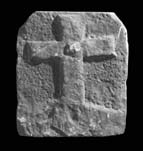
Object type: Grave-marker
Measurements: H. 47 cm (18.5 in); W. 42.5 cm (16.7 in); D. 15.7 cm (6.2 in)
Stone type: Pale yellowish orange (10YR 8/4) with some traces of pink, fairly hard, fairly well sorted fine- to medium-grained (0.2 to 0.3 mm) sandstone. Angular to sub-angular grains, mainly quartz. Most of the surface is obscured, possibly by paint. Probably a sandstone within the Salop Formation, Warwickshire Group of the Upper Carboniferous, but could be from the Bromsgrove Sandstone Formation (Helsby Sandstone Formation), Sherwood Sandstone Group, middle Triassic.
Plate numbers in printed volume: Ills. 551-2
Corpus volume reference: Vol 10 p. 309-10
(There may be more views or larger images available for this item. Click on the thumbnail image to view.)
Plain grave-marker. The stone is rectangular with a flat top, and is carved on both faces with small, almost identical, crosses in shallow relief. On face A the stem of the cross is straight and it stands on a low, gable-like 'hill'. On face C the stem is broader and tapered, and the top of the low 'hill' on which it stands slopes to the right side of the cross-shaft but is flatter to the left. On both crosses the arms are slightly wedge-shaped, the upper arm in each case being more pronounced that the cross-arms. At the centre of both cross-heads there is a small raised boss. The top of the stone seems to have been trimmed back to its present shape for reuse, and the chamfered corners may be the remaining lower parts of a once-curving head to the stone (although the chamfered corners on the head of the very similar grave-marker from Bromfield, Shropshire (Bromfield 1, Ill. 542) seem to be part of the original shape).
Similar (tenth-century) crosses carved in shallow relief with a small raised boss at the centre of the head has been found on a grave-marker from Ponteland, Northumberland and on a cross-base from Chester-le-Street, Co. Durham (Cramp 1984, 58–9, 217, pls. 28.148, 210.1201). The low, slope-sided 'hill' or calvary on which the cross stands on face A of the Shrewsbury stone is in particular similar to that on face C on the Chester-le-Street cross-base. Two rather more elaborate, probably tenth-century grave-markers with cable-moulded border from Hackthorn, Lincolnshire are incised and double-sided like both grave-markers from St Mary's, but the crosses are straight-sided and outlined with a small incised boss at the crossing (Everson and Stocker 1999, 167, 175, ills. 180–4, 191, 193). A tenth-century date for this small grave-marker therefore seems likely.
