Select a site alphabetically from the choices shown in the box below. Alternatively, browse sculptural examples using the Forward/Back buttons.
Chapters for this volume, along with copies of original in-text images, are available here.


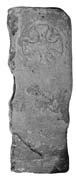
Object type: Grave-cover
Measurements: H. 122 cm (48 in); W. 47 > 43 cm (18.5 > 16.9 in); D. 17.5 cm (6.9 in)
Stone type: Greyish yellow (5Y 7/4), fairly well sorted, very fine to medium-grained (0.1 to 0.3 mm) sandstone. Grains mainly quartz with some feldspar and a dark mineral. Possibly Grinshill Sandstone which is a variant of the Helsby or Bromsgrove Sandstone formations, part of the Sherwood Sandstone Group and middle Triassic in age.
Plate numbers in printed volume: Ill. 556
Corpus volume reference: Vol 10 p. 311
(There may be more views or larger images available for this item. Click on the thumbnail image to view.)
Noted by Leighton (1882, 253, fig. 21); Leighton gives no information as to the earlier history of this stone.
Grave-cover with ring-headed cross. The cross-head is an equal-arm C10 type with rounded armpits and chamfered arm terminals. The background between the arms of the cross-head is cut back to form four slightly domed areas, the centres of two of which are incised with 'Y'-shapes. The encircling ring is incised. Much of the stone is heavily weathered, but it seems clear that there was never a shaft on the cross.
This form of cross-head is unusual, with the encircling element outside the ends of the arms. There is a ninth-century example with a D9-type cross on a grave-marker from Gilling West, northern Yorkshire (Lang 2001, 117–18, ill. 292), a pierced ninth- to tenth-century example with a fan-armed cross type E9 from Amesbury, Wiltshire (Cramp 2006, 199–20, ills. 383–7), and a similar cross-head from Leek, Staffordshire (Jeavons 1945–6, 119, pl. xxiv, fig. 1). The head of the cross on an eleventh-century grave-cover from Gainford, Co. Durham, is also surrounded in a similar manner, but by the curving top of a roll moulding that also surrounds the shaft of the cross (Cramp 1984, 88, pl. 74.361). There are also a ninth-/tenth-century example from Llangamarch, Breconshire, and several from Glamorgan, ranging in date from the simple seventh-/ninth-century example from Llantwit-Juxta-Neath to eleventh-century examples from Laleston and Ewenni and an eleventh-/twelfth-century example from Llan-Gan (Redknap and Lewis 2007, 202–3, 300, 313–14, 343, 367–8, cats. B27, G24, G32, G46, G61). The shape of the cross-head on Shrewsbury St Mary 4 is, however, most similar to tenth-century crosses from the Isle of Man and this may betray a link similar to that suggested for no. 3 (see above). A date in the tenth century for this carving would therefore seem most likely.
