Select a site alphabetically from the choices shown in the box below. Alternatively, browse sculptural examples using the Forward/Back buttons.
Chapters for this volume, along with copies of original in-text images, are available here.


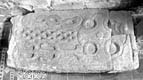
Object type: Grave-cover
Measurements: H. 120 cm (47.2 in); W. 62 > 52 cm (24.4 > 20.4 in); D. 17.5 cm (6.9 in)
Stone type: Moderate reddish brown (10R 5/6), friable, fairly well sorted, fine to medium-grained (0.2 to 0.3 mm) sandstone. Grains sub-angular to sub-rounded with some well rounded, mainly quartz but with some mica. Most of the surface is obscured, possibly by paint. Probably a sandstone within the Salop Formation, Warwickshire Group of Upper Carboniferous, but could be from the Bromsgrove Sandstone Formation (Helsby Sandstone Formation), Sherwood Sandstone Group, middle Triassic.
Plate numbers in printed volume: Ills. 553-5; Fig. 29D
Corpus volume reference: Vol 10 p. 310-11
(There may be more views or larger images available for this item. Click on the thumbnail image to view.)
Leighton (1882, 252, fig. 3) states that this stone 'was 'found built under one of the northern pillars of the Norman arches in the nave'. Both Smith (1953, 14) and Carver (1969–74, 252) state that the discovery took place during installation of a heating system. Smith assigns the discovery to 1880, while Carver gives a date of 1850, but neither quotes a source for the dates given. Work on the heating system in 1879–80 seems to have been limited to the provision of a new boiler (Shropshire Archives, P257/C/2/1 and P257/B/3/10). A more likely date for the discovery may be 1864, when, as the incumbent related with reference to the nave and aisles, 'We took up the whole floor, and having occasion to secure sundry, but not many, vaults and graves within the church, and to provide channels for hot water pipes and gas mains, a thorough investigation of the whole foundation became necessary' (Lloyd 1900, 136–8).
Grave-cover with an equal-arm cross of type E9 in low relief with curved armpits and the expanding arms ending in curved terminals. The spaces between the curving arms of the head are filled with outlined incised circles, the centres of which are cut down to emphasise the form of the head. There is a small flat boss at the centre of the cross-head. The shaft of the cross consists of a narrow vertical panel of tight four-strand plait. To one side of the shaft there is a simple plant form with two buds at the top of the main stem and two pairs of downward-curving side stems. On the other side of the shaft there is a heavy, flat-bodied, serpentine creature biting its own tail. There is an incised edge moulding around the surviving borders of the stone. The side faces are plain.
This fine grave-cover is very similar to some of the early slabs from the Isle of Man, for example the tenth-century Olaf Liotulfson's Cross from Ballaugh (Cubbon 1983, 21, illus.), and offers a rare example of possible Scandinavian influence in tenth-century west Mercian sculpture. The early tenth century also saw a Scandinavian colony established on the Wirral by Norsemen from Ireland (Gelling 1992, 132–4), and contact with this area might offer an alternative source of influence. The cross-head is similar to that of the tenth-century Grutne cross from Margam, Glamorganshire (Redknap and Lewis 2007, 422–5, cat. G81) and an eleventh-century grave-cover from Gainford, Co. Durham (see no. 4 below). However this cross-head is not actually encircled and as such, in the shape of the arms, it is also related to a long-lived Anglian tradition seen for example in the fragment of a late eighth-century cross-head from Bath, Somerset (Cramp 2006, 141, ills. 175–6), or a rather squarer tenth-/eleventh-century cross-head from Kirklevington and the cross-heads on the double-ended cross on a similarly dated grave-slab from Spennithorne, both in northern Yorkshire (Lang 2001, 150–1, 198, ills. 450, 452, 745). The tenth century would seem to offer the most likely time for a carver in this area to be open to both sets of influences.
