Select a site alphabetically from the choices shown in the box below. Alternatively, browse sculptural examples using the Forward/Back buttons.
Chapters for this volume, along with copies of original in-text images, are available here.


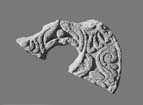
Object type: Part of a double-sided carving (grave-marker?)
Measurements: H. 37.5 cm (14.7 in); W. 53.5 cm (21 in); D. 9 < 10.3 cm (3.5 < 4 in)
Stone type: Yellowish grey (5Y 7/2), poorly sorted, matrix-supported, shelly oolite. Some of the ooliths have fallen out to give an 'aero-chocolate' texture. The ooliths range from 0.2 to 0.5 mm, but are mostly between 0.3 and 0.4 mm. Sub-rounded and platy shell fragments up to 6 mm across occur. Shells, matrix and ooliths occur in roughly equal proportions. Taynton Limestone Formation? Great Oolite Group, Middle Jurassic.
Plate numbers in printed volume: Ills. 426-8
Corpus volume reference: Vol 10 p. 243-5
(There may be more views or larger images available for this item. Click on the thumbnail image to view.)
None. First mentioned in several papers published in 1893–4 ((—) 1893–4b, 49; Allen 1893–4, 50, 62, 65, fig.; Goddard 1893–4, 48; Ponting 1893–4, 28). At this time the sculpture was placed in a niche left open internally at the head of the early doorway in the north wall of the nave (Ponting 1893–4, 28); the Rev. Canon Geoffrey Gibbon suggested c. 1970 that this niche was in all likelihood created expressly to hold the sculpture, probably in 1875–6 at the behest of F. S. Waller (the architect) during the restoration of those years (Gloucestershire Archives, P303 MI 3). The restoration of 1875–6 was extensive and large parts of the church were rebuilt (Verey and Brooks 1999, 615–16; Gloucestershire Archives, P303 IN/4/5); in all likelihood the fragment was discovered at this time.
The stone takes the form of two opposed beasts, their mouths touching and holding a round ball between them. One head is reduced to a snout and mouth, but the other retains mouth, eyes and strong curving neck. Unusually the stone is carved actually to the shape of the creatures, and pierced completely below the mouths. The mouths of both creatures have curling tips to the upper and lower lips, and the junction between jaws and face is outlined by a lapet. There are no teeth, so the mouths could be beaks. The top of the head of the more complete creature is damaged, but the line of the neck curves up abruptly immediately below the damaged area, indicating that the creature probably bore a crest or comb. The eyes are emphasised by fans of bold, lobed eyelashes. The back, outlined by a plain simple moulding, is covered on face A by a rather flat nest of leaves (on its side) from which grows a larger bud and a wide, median-incised, spiralling shoot that ends in a rounded tip. Part of what is probably a second spiral shoot survives just below the bud, while a plant tendril with a claw-like terminal fills the rest of this face. There is a similar tendril with a claw-like terminal on face C, but here most of the face is covered by a median-incised plant stem that ends in a lobed tendril and a bud sprouting from curving, fleshy leaves.
This Somerford Keynes stone is clearly influenced by the Ringerike style, so called after the geological name for sandstone beds in the Oslo region of Norway which were a source of some finely ornamented slabs (Graham-Campbell and Kidd 1980, 168). A date for the piece in the first half of the eleventh century would, therefore, be most likely.
The two Somerford Keynes beasts belong to a tradition which is best shown, both engraved and in the round, on a ship's gilded bronze weather-vane from Heggen in Norway and on a magnificent grave-marker from St Paul's churchyard in London (Graham-Campbell and Kidd 1980, figs. 9, 99, 101; Tweddle et al. 1995, 226–8, ill. 351). Another (possibly post-Conquest) fully three-dimensional animal head carrying Ringerike-style carving comes from St Mary's church in Hardington Mandeville, Somerset. This beaked creature has large bulbous eyes, with curling tendrils in the open mouth and above the upper mandible (Gittos and Gittos 1997, 64–6, pl. 12; Cramp 2006, 191). Reginald Smith (1913–14a. 66–7) offered a more local parallel when he observed the similarities between the Somerford Keynes beasts and those on a grave-marker from Bibury (Bibury St Mary 1, Ill. 27). The Bibury stone was part of a group of carved stones found just outside St Mary's church (see p. 134). Somerford Keynes is only c. 10 miles (16 km) from Bibury, and this proximity, allied to the similarities in style, makes it possible that the carvings at both sites were from the same workshop.
As to function, there have been various interpretations. One writer, unnamed but in practice certainly Romilly Allen, suggested that the fragment was from the headstone of a grave and drew a comparison with a similar representation 'of the same intensely Scandinavian character' on the grave-marker from St Paul's mentioned above ((—) 1893–4, 49). MacKay suggested that the piece was part of a tympanum, an error which may indicate that he only saw one side (MacKay 1963, 80). It has also been suggested that it could be part of an ornate chair. Fragments of several stone chairs, as well as two complete 'frith stools', survive in the north of England, but they belong to an earlier date (Cramp 1984, 9–10; Lang 1991, 20). The closest parallels are, however, provided by a group of Ringerike-decorated grave-markers and grave-covers from All Hallows' and St Paul's churches in the city of London, Rochester cathedral (Kent) and Great Canfield (Essex) (Tweddle et al. 1995, 165–7, 209–10, 223–9, fig. 32, ills. 147, 341–2, 351). While none of these stones is carved to an animal shape, three of the grave-markers are decorated on both faces and one may be pierced. It is likely, therefore, that Romilly Allen's suggestion was right and that the Somerford Keynes fragment is part of a head or foot stone, possibly associated with a recumbent slab.
Somerford Keynes was in Wiltshire until 1897, when it was transferred to Gloucestershire. This is the only site listed in the present volume which was in Wessex; it was in the medieval diocese of Salisbury. Somerford Keynes was apparently granted to Malmesbury Abbey in the late seventh century (Sawyer 1968, no. 1169; Kelly 2005, no. 5), but its subsequent pre-Conquest history is unknown and it was not in the hands of the abbey at the time of the Domesday survey.
