Select a site alphabetically from the choices shown in the box below. Alternatively, browse sculptural examples using the Forward/Back buttons.
Chapters for this volume, along with copies of original in-text images, are available here.


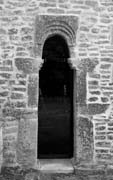
Object type: Carved doorhead
Measurements:
Doorhead: (stone panel) H. 82 cm (32.2 in); W. 77 cm (30.3 in); D. 28 < 33 cm (11 < 13 in); (internal dimensions of arch) H. 48 cm (18.9 in); W. 54 cm (21.2 in)
Imposts: (eastern) H. 26 cm (10.2 in); W. (max.) 55 cm (21.6 in); (western) H. 23 cm (9 in); W. (max.) 58 cm (22.8 in)
Stone type: Greyish orange (10YR 7/4), poorly sorted, matrix-supported, bio-oomicrite. Ooliths range from 0.3 to 0.6 mm, but mostly are in the range 0.4 to 0.5 mm; most ooliths have weathered or fallen out to give an 'aero-chocolate' texture; they form about 60% of the rock. Sub-angular to sub-rounded (a few elongate) shell fragments up to 5 mm across form about 5 to 10% of the stone. Taynton Limestone Formation, Great Oolite Group, Middle Jurassic.
Plate numbers in printed volume: Ills. 431-3; Fig. 20A
Corpus volume reference: Vol 10 p. 245-6
(There may be more views or larger images available for this item. Click on the thumbnail image to view.)
In situ. First noted in 1893–4 ((—) 1893–4b; Allen 1893–4, 50, fig.; Ponting 1893–4, 27–8) and perhaps covered by render and/or vegetation prior to the restoration of 1875–6 (see no. 1).
The doorhead, formed from a large, edge-bedded stone panel, is set on stepped imposts above the 'Escomb fashion' jamb-stones of the doorway which are themselves set on square plinths. The jambs and imposts are through-stones. The doorhead panel, which passes almost halfway through the wall, is cut away to form a narrow, stilted arch, above which a shallow semicircular area has been cut back into a shallow recess leaving two concentric bands of cable moulding in relief. Small horizontal fillets stop the bands of cable moulding about 20 cm (7.9 in) above the imposts. Inside the church the doorhead is formed from six irregular, non-radial voussoirs that extend through the remaining thickness of the wall. The jambs carry later rebates.
This tall, narrow doorway has been discussed many times. Stenton suggested that the church at Somerford Keynes might be the work of Abbot (later Saint) Aldhelm in the late seventh or early eighth century (Stenton 1971, 151), and Taylor and Taylor supported this idea by placing the church in their Period A2/3 which is ad 650 to 800 (Taylor and Taylor 1965, ii, 556). Baldwin Brown proposed a date in the eighth century (Brown 1925, 189) and this has recently been supported in descriptions of the church by Verey and Brooks (1999, 615). MacKay suggested a late eighth-century date (MacKay 1963, 73), but compared the distinctive stepped imposts to those now dated ninth to early tenth century at Deerhurst (Deerhurst St Mary 24 and 25, pp. 189–90, Ills. 218–25). Moreover, the cable mouldings are similar to the double-cable decoration on a tenth-/eleventh-century window at Boarhunt, Hampshire (Tweddle et al. 1995, 251, ills. 420, 423–4). An early tenth-century decorated arch stone was found during the excavations at St Oswald's Priory, Gloucester (Gloucester St Oswald 17, Ills. 324–5), and a tenth- to early eleventh-century example comes from Coventry, Warwickshire (no. 2, Ills. 589–91). In St Mary's church, Seaham, Co. Durham, two windows in the north wall, each with a round head cut from two monolithic stones set back to back, are carved with shallow, concentric incised grooves on the outer and inner faces of the window head. The eastern of the two windows also carries 'wheat-ear' ornament, rather like flat double cable, on the soffit. These windows are dated to the seventh to ninth centuries (Cramp 1984, 135, pls. 125.697, 126.698–9, 127.700). Another parallel can be found in the ruins of St Patrick's chapel in Heysham, Lancashire, where the arch over the surviving doorway in the south wall carried carved decoration on the outer and inner faces. The jambs of this doorway are constructed from massive through-stones laid in 'Escomb fashion', the eastern jamb rather more successfully than the western jamb. The outer face of the doorhead is enriched by three concentric bands of plain half-round mouldings separated by hollow mouldings of roughly semi-circular section. The inner face of the doorhead carries concentric half-round mouldings of a simpler design. Bailey has recently suggested that this doorhead could possibly date to the eighth century (Bailey 2010, 209–10, ills. 545–6). It will be seen that the dates proposed for the Somerford Keynes doorway and similarly decorated openings range from the seventh to the eleventh centuries. The present author believes that a date in the tenth century for the Somerford Keynes doorhead would seem most probable.
