Select a site alphabetically from the choices shown in the box below. Alternatively, browse sculptural examples using the Forward/Back buttons.
Chapters for this volume, along with copies of original in-text images, are available here.


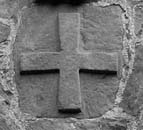
Object type: Panel with cross in relief
Measurements:
Backing panel: H. 57 cm (22.4 in); W. c.53 cm (20.8 in); D. unknown
Cross: H. 49 cm (19.3 in); W. 49 cm (19.3 in)
Stone type: Greyish pink (5Y 8/2) to moderate pink (5Y 7/4), fairly hard, moderately sorted fine to medium-grained sandstone. Grains mainly quartz but with common feldspar, angular to sub-angular (0.2 to 0.4 mm). Adjacent slabs of same stone type show cross-bedding and include mud flake conglomerate. Bromsgrove Sandstone Formation, Sherwood Sandstone Group, middle Triassic.
Plate numbers in printed volume: Ills. 579, 789
Corpus volume reference: Vol 10 p. 323
(There may be more views or larger images available for this item. Click on the thumbnail image to view.)
Set above the north doorway, below Stanton Lacy 2 (Appendix B, p. 324). Visible in drawings published by Hartshorne (1846, 285, 289) and by Petit (P[etit] 1846).
Panel with a plain equal-arm cross in high relief. Each arm is slightly wedge-shaped (type B6, although the horizontal arm is nearer to type A1).
Appendix A item (stones dating from Saxo-Norman overlap period or of uncertain date)
This cross may belong to the late Anglo-Saxon (probably early- to mid-eleventh century) phase still evident in parts of the present church. It is possible that the cross is in its original location, but it seems more probable that it was reset at a later date in its present position, together with the later moulding (Stanton Lacy 2) directly above it. The section of pilaster above these two stones may be in situ, part of the scheme that survives in the west and north walls of the nave and the west and east walls of the north transept (see Ill. 789). The jambs of the north doorway are outlined with strip mouldings.
In Domesday Book two priests are recorded at Stanton Lacy (Thorn and Thorn 1986, no. 7, 4). It has been suggested that Stanton Lacy is likely to have been a minster church (Croom 1988, 72).
