Select a site alphabetically from the choices shown in the box below. Alternatively, browse sculptural examples using the Forward/Back buttons.
Chapters for this volume, along with copies of original in-text images, are available here.


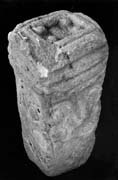
Object type: Reused Roman altar with inscription
Measurements: H. 68 cm (26.7 in); W. 22.4 cm (8.8 in); D. 19 cm (7.5 in)
Stone type: Greyish orange (10YR 7/4) sandstone with sub angular to sub rounded quartz grains which range in size between 0.2 to 1 mm. The matrix is pale in colour and may be kaolinitic. A sandstone, perhaps Pennant Sandstone from the local Forest of Dean Coal Measures, Upper Carboniferous
Plate numbers in printed volume: Ills. 417-25; Fig. 44
Corpus volume reference: Vol 10 p. 241-3
(There may be more views or larger images available for this item. Click on the thumbnail image to view.)
This stone was originally found in the late 1960s by Mr H. J. Baker of Close Turf Farm, St Briavels. The stone was unearthed during dredging by bulldozer of a marshy area to the north of the farm (in the vicinity of grid reference SO 583053); the stream which emerges from this marshy area flows past the south side of the Roman temple and villa complex at Lydney Park on its way to the Severn. In early 1980 the stone was noticed by Michael Hare in the farmyard, and it was then taken to Gloucester City Excavation Unit for cleaning, photography and further study. The stone was subsequently displayed in Gloucester Cathedral before being transferred to its current location.
Reused Romano-British altar with inscribed lettering on all four faces. The shaft is rectangular in plan and tapers slightly at the bottom.
Inscription I have not personally examined this stone and have therefore worked from photographs. The following readings and interpretation are thus to be seen as preliminary and tentative only. The texts are transliterated into capitals in lines as on the stone. The following conventions are used:
A indicates a legible letter A;
A indicates a letter probably to be read as A;
[A] indicates a letter which might read A;
[.] indicates a lost letter;
/ indicates two letters joined to each other.
The four faces of the stone each contain text and in each case the letters are set upside down with reference to the top of the Romano-British altar. The lettering is unlikely to be a Romano-British inscription, however, and probably represents later reuse of the altar. This upside-down setting may suggest ignorance or disregard on the part of the later inscriber; alternatively, as Johns suggests, the altar could have had the inscription added while it was upside down in the ground (Johns 2005, 39).
Face A contains three lines of text which might read:
F E C I/T
N O C V
C [. E] O
Face B contains three lines of text which might read:
O
C/A R
[. . .]
The first lost letter could read C or G.
Face C contains two lines of text which might read:
[O .]
[C] A R
The letter O is clear but has an oblique line descending from it; the letter read as C might instead read E.
Face D is now much eroded but clearly also contained two or three lines of text. There is a possible letter E at the end of the top line. The middle line (if such it is) is now illegible but the bottom line could be read as:
[F] A
Inscription The reading fecit 's/he made' indicates that the text is in Latin. It is probable that the text read continuously around the four faces of the stone. The verb fecit probably implies that a personal name also occurred on the stone and this name would have been likely to precede the verb. This suggests that face A, containing fecit, was not the beginning of the text. A following predicate, such as hanc petram 'this stone', or possibly me 'me', might have been expected, but the remaining text on the altar does not seem to have contained either. The verb fecit occurs occasionally on Anglo-Saxon stone inscriptions, for example on 161 Canterbury VII (Okasha 1983, 88–9, pl. II; Tweddle et al. 1995, 128–31, ills. 24–8), although it is more frequent in texts on non-stone, portable objects (see Okasha 1994, 71–7). The verb fecit does not occur in the earlier inscriptions of Cornwall, where formulae containing filius 'son of' and hic iacet 'here lies' are more usual. Many inscribed stones had some sort of memorial function and it is possible that the Romano-British altar was reused with such a function in mind. The script used in the altar texts is a capital script but, without examining the actual altar, I am unable to suggest an epigraphical dating.
As noted above, the Romano-British altar has been reused upside down with little or no regard to its original function. This strongly suggests that the inscription belongs to the post-Roman period. The fact that the only decipherable word fecit is in Latin might be an indication that this stone is an early medieval monument similar to inscribed stones from south-east Wales in which fecit or ficit is used, for example the apparently fifth-century inscription from Aberdâr in Glamorgan or the ninth-century inscription at Llanddeti in Breconshire (Redknap and Lewis 2007, 172–6, 264–5, ills. B10, G3). Fecit also appears in a ninth-/tenth-century inscription on Llanveynoe 1, Herefordshire (p. 287, Ill. 511). However, as Elisabeth Okasha has shown above, most of the letters on the St Briavels stone make little coherent sense. Perhaps this is the work of an illiterate carver working for a patron who was himself at best semi-literate but who knew the sort of monument that was needed to commemorate a dead relative. St Briavels is derived from Briauail, a Welsh personal name which is found in early charters, and there are other links to Welsh/British sixth- and seventh-century saints in the Forest of Dean area (Heighway 1987, 94). If this is a 'British' monument, then it does not strictly come under the remit of the Corpus, but the stone is included here because it does not readily find a 'home' in any other collection of early medieval carved stones in England.
