Select a site alphabetically from the choices shown in the box below. Alternatively, browse sculptural examples using the Forward/Back buttons.
Chapters for this volume, along with copies of original in-text images, are available here.


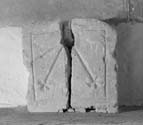
Object type: Sundial
Measurements: H. 25 cm (9.8 in); W. 25 cm (9.8 in); D. 9 cm (3.5 in)
Stone type: Very pale orange (10YR 8/2) clast-supported, micritic oolite, with ooliths ranging from 0.3 to 0.6 mm, but mostly in the range 0.4 to 0.5 mm, with one or two up to 1.0 mm; most ooliths have weathered or fallen out to give an 'aero-chocolate' texture. The ooliths form about 80% of the stone. Shell fragments, which form about 1% of the stone, are up to 2 mm across. Cleeve Cloud Member, Birdlip Limestone Formation, Inferior Oolite Group, Jurassic.
Plate numbers in printed volume: Ills. 494-5
Corpus volume reference: Vol 10 p. 274-5
(There may be more views or larger images available for this item. Click on the thumbnail image to view.)
None. Perhaps discovered during the restoration of 1898–9 (Verey and Brooks 1999, 635–6).
Square sundial. The dial has a wide, plain border that varies in width from 3.3 cm to 2.5 cm (1.3 to 1 in). The inside edge of the border is marked by an incised line. The dial itself is divided into four by incised lines, with the three principal divisions carrying cross-bars. There are a further five incised dials still in situ on the south side of the church.
Appendix D item (sundials presumed to be of pre-Conquest date).
The four segments of this dial presumably equate to the 3-hour tides into which the Anglo-Saxons divided the day (Green 1928, 489–516), and the dial is, therefore, almost certainly pre-Conquest in date. Although rather crudely carved, the three principal division markers on the Stowell dial are similar to other late Anglo-Saxon dials from Somerset and Hampshire (see Saintbury 2 discussion, p. 274).
