Select a site alphabetically from the choices shown in the box below. Alternatively, browse sculptural examples using the Forward/Back buttons.
Chapters for this volume, along with copies of original in-text images, are available here.


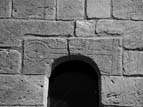
Object type: Grave-cover
Measurements: (Estimated from ground) H. (original width) c.35 cm (13.8 in); W. (original length) c.75 cm (29.5 in); D. unknown
Stone type: Oolitic limestone, but too high for detailed examination
Plate numbers in printed volume: Ill. 484
Corpus volume reference: Vol 10 p. 265-6
(There may be more views or larger images available for this item. Click on the thumbnail image to view.)
This stone slab, probably a grave-cover, has been reused as a window lintel in the early twelfth-century six-sided tower. The round head for the lancet window has been cut into the lower half of the stone. The stone bears an incised design that appears to be part of a simple ring-head cross (type A1 with ring type b), with a circular, open-centred boss on the shaft. The stone has been cut down on all four sides, so that parts of the design are missing, in particular the upper half of the head and the lower part of the shaft.
Appendix A item (stones dating from Saxo-Norman overlap period or of uncertain date).
The reuse context in the early twelfth-century tower indicates that the stone must belong to the eleventh century or earlier. The tower is a single build without any obvious alteration, and the top stage has early twelfth-century two-light openings in each face. Incised carving of this date is unusual in Gloucestershire, although there are two mid eleventh-century incised inscriptions at Deerhurst (Deerhurst Odda's Chapel 1 and 2, Ills. 226–33). The technique is more common in western Herefordshire (Ills. 506, 508–13, 517–22, 532–3, 536) and there is an incised headstone at Shrewsbury in Shropshire (Shrewsbury St Mary 1, Ills. 548–50).
