Select a site alphabetically from the choices shown in the box below. Alternatively, browse sculptural examples using the Forward/Back buttons.
Chapters for this volume, along with copies of original in-text images, are available here.


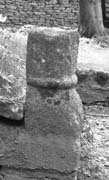
Object type: Capital with section of shaft
Measurements:
H. (total) 33 cm (13 in); Capital: H. 15 cm (5.9 in); W. 19 cm (7.5 in); D. 17.5 cm (6.9 in)
Remains of column: H. 14 cm (5.5 in); W. 14 cm (5.5 in); D. 16 cm (6.3 in)
Stone type: Yellowish grey (5Y 8/1) matrix supported shelly oolite with sparry matrix and hollow ooliths. The size of the ooliths measured across the cavities ranges from 0.1 to 0.2 mm, the outer margins of the ooliths being indistinct. The shell debris is up to 4 mm. Bedding is parallel to the shaft. Cleeve Cloud Member, Birdlip Limestone Formation, Inferior Oolite Group, Middle Jurassic.
Plate numbers in printed volume: Ills. 485-6
Corpus volume reference: Vol 10 p. 266
(There may be more views or larger images available for this item. Click on the thumbnail image to view.)
This simple, slightly rounded, chamfered capital is at present set upside down. The capital is carved integrally with a bellied shaft of slightly oval section, and separated from the shaft by a roll moulding 4 cm (1.6 in) wide.
Appendix A item (stones dating from Saxo-Norman overlap period or of uncertain date).
The chamfered capitals, Syde 2 and 3, are like simple 'cushion' capitals and as such they could have been carved at almost any point in the eleventh or early twelfth century. However, bellied (or baluster) shafts are a common feature of pre-Conquest buildings. They are used, for example, as mid-wall shafts in the double windows on both sides of the late Anglo-Saxon nave at Worth, Sussex (Taylor and Taylor 1965, ii, 688–93, figs. 353, 354; Gem and Keen 1981, 15). Moulded baluster shafts, dated to the first half of the eleventh century, were recovered from excavations at St Edmund's Abbey, Suffolk (Gem and Keen 1981). Syde 2 and 3 could, therefore, be late Anglo-Saxon in date. In the church, the south doorway (now blocked) carries a huge, flat lintel and it has been suggested that this could be an Anglo-Saxon doorway, the surviving element of a stone church standing on the site before the present late eleventh-century building (Verey and Brooks 1999, 680). This suggestion receives support from the presence of the foliated capital (Syde 1, p. 250, Ills. 441–5) in the churchyard on the north side of the church. Alternatively nos. 2 and 3 might have been part of a now replaced chancel associated with the surviving late eleventh-century nave. An eleventh-century date is, therefore, probable and, if Syde 2 and 3 are contemporary with no. 1, this could have been in the first half of the century.
