Select a site alphabetically from the choices shown in the box below. Alternatively, browse sculptural examples using the Forward/Back buttons.
Chapters for this volume, along with copies of original in-text images, are available here.


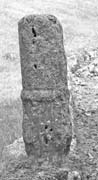
Object type: Capital and part of column shaft
Measurements:
H. (total) 34 cm (13.4 in); Capital: H. 14.5 cm (5.7 in); W. 12 < 12.5 cm (4.7 < 4.9 in); D. 12 cm (4.7 in)
Remains of column: H. 17 cm (6.7 in); Diam. 11 cm (4.3 in)
Stone type: Yellowish grey (5Y 8/1) matrix supported shelly oolite with sparry matrix and hollow ooliths. The size of the ooliths measured across the cavities ranges from 0.1 to 0.8 mm, the outer margins of the ooliths being indistinct. The shell debris ranges between 2 and 4 mm in size. Three cavities at the top of the shaft either shell casts or intraclasts. Cleeve Cloud Member, Birdlip Limestone Formation, Inferior Oolite Group, Middle Jurassic.
Plate numbers in printed volume: Ills. 441-5; Fig. 22G
Corpus volume reference: Vol 10 p. 250
(There may be more views or larger images available for this item. Click on the thumbnail image to view.)
This architectural piece is at present set upside down. The capital is square tapering to octagonal above a simple roll molding 2.5 cm wide. The capital is carved integrally with the column which is circular in plan. Immediately above the roll moulding, if the column is turned the right way up, it can be seen that the plan of the capital becomes octagonal because each face is carved with a tall, curving-topped and slightly out-curving shape like an acanthus leaf, with a space of equal width between each leaf. Up through these spaces rise what seem to be more tall leaves (the exact details are difficult to see) and these appear to cover the rest of the capital.
The leaves on this small capital are ultimately derived from those on classical Corinthian capitals, a style that was reintroduced into Europe architecture during the Carolingian renaissance. The Syde leaf forms are rather similar to those on a Carolingian inspired ninth-century capital from Canterbury (Tweddle et al. 1995, 131, ills. 29–32), but they are also similar to later, acanthus-style palmettes such as those found on late tenth-/early eleventh-century fragments from St Oswald's Priory in Gloucester (St Oswald 12 and 13, Ills. 310–14). Stiff leaves rising between out-turning leaves can be seen above capitals in a mid tenth-century manuscript frontispiece of Hrabanus Maurus possibly from Christ Church, Canterbury (Temple 1976, 42–3, cat. 14, ill. 48). Parallels for rather more florid stiff-leaved acanthus can be found, for example, in the Salisbury Psalter, dated to 969–78 (Salisbury, Cathedral Library MS 150: Temple 1976, 45–6, cat. 18, ill. 57), or in the early eleventh-century Trinity Gospels (Cambridge, Trinty College MS B.10.4: Backhouse et al. 1984, 68, cat. 49, pl. XIII). In stone, parallels for the acanthus palmette can be drawn with a tenth-century impost fragment from Avebury in Wiltshire (Cramp 2006, 201, ill. 396), and to the foliate decoration on the belfry openings at Langford in Oxfordshire where the tower has been dated, on architectural grounds, to the mid eleventh century (Tweddle et al. 1995, 215, ills. 297–312). The Syde leaf forms are also similar in concept to the foliate decoration on two eleventh-century capitals from Frocester, and to the rather more luxuriant eleventh-century decoration on the chancel-arch capitals at Bibury, both in Gloucestershire (Frocester 1 and 2, Ills. 248–9; Bibury 8 and 9, Ills. 43–4). The facetted nature of the capital on the Syde column can be paralleled on an eleventh-century baluster shaft from North Leigh in Oxfordshire (Tweddle et al. 1995, 244, ills. 400–3). A date in the first half of the eleventh century would be acceptable for this capital and shaft.
