Select a site alphabetically from the choices shown in the box below. Alternatively, browse sculptural examples using the Forward/Back buttons.
Chapters for this volume, along with copies of original in-text images, are available here.


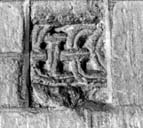
Object type: Fragment
Measurements: H. 17.5 cm (6.9 in); W. 23.7 cm (9.3 in); D. unknown
Stone type: Greyish orange (10YR 7/4) shelly, matrix-supported, micritic oolite. Ooliths, which form about 70% of the rock range from 0.2 to 0.5 mm and have all fallen out to give an 'aero-chocolate' texture. Thin shell fragments up to 10 mm across form some 5–10% of the rock. Cleeve Cloud Member? Birdlip Limestone Formation, Inferior Oolite Group, Jurassic.
Plate numbers in printed volume: Ill. 446
Corpus volume reference: Vol 10 p. 251
(There may be more views or larger images available for this item. Click on the thumbnail image to view.)
Discovered during restoration in 1884–5 ((—) 1887, 205).
Fragment, probably from a cross-shaft, with heavy cable mouldings on both edges. The correct orientation would require the stone to be turned through 90 degrees. The face of the shaft is covered with a median-incised, repeating pattern in relief, with the background cut back by c. 2 cm (0.8 in). The pattern consists of looped strands piled on top of one another and linked by a central vertical strand (cf. Cramp 1991, fig. 26, Cv). At one point a stray horizontal strand cuts across the vertical. This is terminated on the right by a short strand which should perhaps be considered to be part of the loop above that has become displaced to the left, somewhat closer to the main vertical element.
This carving is exceedingly 'rustic', but is similar to the two-strand ring-chain on, for example, the Gosforth cross (Cumberland) that is dated to the first half of the tenth century (Bailey and Cramp 1988, 100–4, ills. 289, 292). The Temple Guiting carving is probably a contemporary attempt to copy one of the design motifs, that of interlocking circles, found on a group of stones dated to the first half of the eleventh century from around Cirencester. Examples can be found at Bisley (the interlocking chain of lozenge-shaped loops on Bisley 1) and Bibury (interlocking circles on Bibury 5), or, less than seven miles away from Temple Guiting, the interlocking circles linked by a vertical moulding on Broadwell 1 (see Ills. 40, 45, 87). The Temple Guiting stone should, therefore, also be dated to the first half of the eleventh century.
