Select a site alphabetically from the choices shown in the box below. Alternatively, browse sculptural examples using the Forward/Back buttons.
Chapters for this volume, along with copies of original in-text images, are available here.


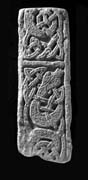
Object type: Incomplete cross-shaft
Measurements: H. 63 cm (24.8 in); W. 26 > 20.5 cm (10.2 > 8.1 in); D. 21.5 > 18.8 cm (8.5 > 7.4 in)
Stone type: Yellowish grey (5Y/8/1) oolite, sparry matrix supported with some shell debris. Many ooliths hollow (0.5 to 0.9 mm). Shell debris 1–2 mm. Bedding parallel to faces B and D. Possibly Cleeve Cloud Member, Birdlip Limestone Formation, Inferior Oolite Group, Middle Jurassic.
Plate numbers in printed volume: Ills. 660-7; Figs. 24P-R
Corpus volume reference: Vol 10 p. 365-7
(There may be more views or larger images available for this item. Click on the thumbnail image to view.)
Found built into the south wall during restoration work on the chancel in 1864–5 (Moore 1893–4, 136; Joyce 1931, 58–9).
Part of a cross-shaft. The edge mouldings are wide, plain and square. The background to all the carving is cut back by about 1 cm to leave the carving in shallow relief.
A (broad): There are two panels of mirror-image, median-incised interlace in the upper and lower parts of this face. (i) In the upper panel there is one register of complete pattern C interlace terminating below in two irregular pattern D knots. (ii) The interlace in the lower panel is damaged but the surviving strands form two simple pattern E knots at the top. This panel is 31 cm (12.2 in) high bounded at the top by a 2.3 cm (0.9 in) wide plain border. (iii) Between the panels of interlace, and of similar width, is a recessed area 8 cm (3.1 in) high and 2.7 cm (1.1 in) deep with a deeper socket at the left side that is 7 cm (2.8 in) deep and c. 3 cm (1.2 in) wide. Above the recessed area the border of the upper panel is 1.6 cm (0.6 in) wide.
An irregular, vertical socket has been cut through the lower interlace panel into the hollowed-out centre of the shaft, perhaps as the housing for a door latch or bar when the stone was reused in a building. The hollowing extends downwards to c. 15 cm (5.9 in) above the base. The bottom of this socket consists of three-quarters of a 'pouring hole' drilled downwards at an angle through the bottom of the shaft to allow lead to be poured in to form a jointing 'dowel-cramp' for securing this part of the shaft to a lower section. A drilled hole survives in the centre of the top of the shaft, the remains of a similar fixing between this stone and an upper section of the cross.
B (narrow): There are two panels on this face, the lower of which is 40.5 cm (15.9 in) high bounded at the top by a plain border 2.2 cm (0.9 in) wide. (i) The upper panel contains a serpentine or lacertine body covered with rectangular scales which merge into chevron patterning towards the tail. The tail itself is drawn out into median-incised interlace, while another strand of interlace is wrapped around the body to form a leg that ends in a three-toed foot. (ii) The lower panel contains two broad flat serpentine shapes interlocking and decorated with scales. However, neither creature has a head, so these may have been at the end of the narrow, interlaced parts of the body that are drawn out downwards and widening slightly before they disappear into the damaged portion at the bottom of this face.
C (broad): This face is quite badly damaged. It consists of two panels, the lower of which is 36.5 cm (14.3 in) high bounded at the top by a 2 cm (0.8 in) wide plain border. (i) The upper panel contains elements of two serpentine creatures drawn out into interlace. (ii) The lower panel contains a large serpentine creature enmeshed in interlace. This creature twists round to bite its own body.
D (narrow): As with the other faces this is divided into two panels, the lower being 36.5 cm (14.3 in) high bounded at the top by a plain border 2.1 cm (0.8 in) wide. (i) The upper panel contains a curving-bodied creature, the tail of which is drawn out into median-incised interlace. The creature's body is decorated with triangles. (ii) In the lower panel there is a complete serpentine-bodied creature above part of a second. The head of the upper creature is seen from above and had a blunt snout and lobed eyebrows. The bodies of both creatures are covered with triangles and areas of hatching, and their tails are drawn out into median-incised interlace.
Creatures with contoured, hatched and textured bodies, enmeshed in plant-scrolls or interlace, and 'ribbon-animals' with bodies drawn out into interlace strands, like those on the Tenbury Wells shaft, belong to a widespread group found in western Mercia and western Wessex in the late eighth, ninth and early tenth centuries. They have been the subject of a number of significant studies, most recently by Cramp (2006, 42–8, 71–2), Plunkett (1984, i, 180–202) and Tweddle (Tweddle et al. 1995, 35–40). Within the area covered by this volume, examples can be found at Abson, Aston Blank, Deerhurst, and Gloucester (St Mary-de-Lode, St Oswald, London Road) (Gloucestershire); Acton Beauchamp (Herefordshire); Wroxeter (Shropshire); Cropthorne and Tenbury Wells (Worcestershire). In the south and south-west further examples occur at Colyton and Dolton (Devon); Shaftesbury (Dorset); Chew Stoke, Frome, Glastonbury, Keynsham, Rowberrow, Wells, and West Camel (Somerset); Bradford-on-Avon, Colerne, and Ramsbury (Wiltshire); Little Somborne, Steventon, and Winchester (Hampshire) (Tweddle et al. 1995, 36–7; Cramp 2006, 42–8). Some of these carvings draw on a wide range of animal types and body detailing, and belong to the late eighth or early ninth century. Others, like the Tenbury Wells examples, draw almost entirely on serpentine forms, with the occasional attenuated, and in some case unattached, limb or foot, while their bodies are covered with inscribed geometrical shapes (triangles, dots, and chevrons) rather than contoured hatching. It has been suggested that this last group could be seen as a development from the earlier group, with a period of overlap when both types of creature might be used on the same monuments (Cramp 2006, 46–7). This proposal makes sense of what one actually finds, and a date in the later ninth century or even the early tenth century for those carvings that consist solely of serpentine creatures would seem acceptable. The closest parallel for the Tenbury Wells shaft is, in fact, the ninth-/tenth-century cross-shaft from Ramsbury, Wiltshire (Ramsbury 3 in Cramp 2006, 230, ills. 485–87, 495–97). Not only are the bodies of the creatures on the Ramsbury shaft covered with incised geometric shapes, but on face B there is a large serpentine creature bending back to bite its own body like the creature on Tenbury Wells 1C (Ill. 663), while the head of the creature on face A of the Ramsbury cross is also very similar to that of the creature on Tenbury Wells 1D (Ills. 660, 666). From within the west Mercian area this development and blending of animal types can be seen very clearly on the well known, early ninth-century Gloucester St Oswald 3 cross-shaft (p. 209, Ills. 278–86). There are several beasts on this shaft with bodies that are treated in a naturalistic manner or with carefully contoured hatching, but the salamanders' bodies on face B are filled with chevron (Ill. 286), while the body of another creature on this shaft is filled with a meander pattern (Ill. 285). Also while the heads of the leonine creatures on faces A and D at Gloucester are quite naturalistic, the heads of the salamander-like creatures are more schematic and very similar to the head of the face D creature at Tenbury Wells (Ills. 286, 666). The present author believes that, within the developing sculptural tradition of the west Mercian area, a date in the second half of the ninth century would seem appropriate for the Tenbury Wells cross-shaft.
It has been suggested that the rectangular recessed panel in the middle of face A (Ills. 661, 665) might have been designed to contain a holy relic (Cramp 2001, 152, fig. 1d; Bridges 2005, 222). This suggestion gains credence from the discovery that there is a smaller, deeper, vertical slot within the recessed area. A reliquary placed in this deeper slot could have then been covered with a removable panel (of stone, wood or perhaps even metal) that was big enough to fit the whole recessed area, thus allowing the relic(s) to be taken out for display during relevant festivals. Alternatively the relic might have been normally kept in a shrine in the church and processed to the cross on special days. Similar holes occur in the west face of the North Cross at Sandbach and in the Hedda Stone at Peterborough, and in both cases it has been suggested that they may have housed 'an object of some particular significance', possibly a relic (Henderson 1994, 91; Hawkes 2002, 146; Bailey 2010, 25).
Although Tenbury Wells was in Worcestershire, it was in the medieval diocese of Hereford; it lay towards the western extremity of a tongue of Worcestershire projecting from the north-west corner of the county. According to Hemming, Tenbury had once belonged to the church of Worcester, but had been seized by the Danish Earl Hakon and his followers (Williams 1997b, 385); if Tenbury had indeed belonged to Worcester, this would explain why it was assigned to Worcestershire. Tenbury had a large parish with dependent chapelries and has plausibly been suggested as a minster (Bond 1988, 134; Blair 2005, 115 n.62).
