Select a site alphabetically from the choices shown in the box below. Alternatively, browse sculptural examples using the Forward/Back buttons.
Chapters for this volume, along with copies of original in-text images, are available here.


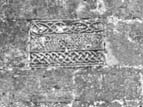
Object type: Carved panel
Measurements: H. 31 cm (12.2 in); W. 42 cm (16.5 in); D. unknown
Stone type: Yellowish grey (5Y 7/2), micritic oolite with ooliths between 0.3 and 0.6 mm, but mostly in the range 0.4 to 0.5 mm. Ooliths form about 50–60% of the rock and most have fallen out to give an 'aero-chocolate' texture. Scattered shell fragments up to 2.5 mm across form less than 5% of the rock. Cleeve Cloud Member?, Birdlip Limestone Formation, Inferior Oolite Group, Jurassic.
Plate numbers in printed volume: Ill. 489
Corpus volume reference: Vol 10 p. 267
(There may be more views or larger images available for this item. Click on the thumbnail image to view.)
Noted by Michael Hare during a visit in March 1978. Previously Daubney (1921, 106) had observed 'a number of carved stones, some perhaps of pre-Norman date'. This fragment was probably one of those seen by Daubney; other fragments built into the walls of the church are of Romanesque date.
This small panel, probably part of an item of interior church furnishing, is delicately carved and divided into three horizontal zones. The panel has a framing border that consists of a narrow roll-moulding. This border is complete along the top, bottom and left side of the panel, but cut off on the right side where part of the decoration is also missing. The upper zone is filled with a loose interlace that is looped around a series of expanded, horizontal, possibly foliated terminals (see discussion below). The central zone consists of a row of large, pyramidal palmettes of leaves pointing alternately upwards and downwards and divided by V-shaped borders. The lower zone carries a tight, four-strand plait.
Appendix A item (stones dating from Saxo-Norman overlap period or of uncertain date).
The carving in the upper and lower zones of this panel could be late Anglo-Saxon in date, but West believes that the leaf forms in the central zone cannot be earlier than the twelfth century (Jeffrey West, pers. comm.). The stone is set too high in the wall to allow for close inspection, but, in some respects, the carving would make more sense if the stone was turned through 90 degrees. Then the expanded horizontal terminals in the present upper zone might be seen as downward-pointing berry bunches at the centre of loosely intertwined vine stems, and the stone itself might be interpreted as part of the carved facing on the jamb of an opening (cf. Cramp 2006, ill. 411).
