Select a site alphabetically from the choices shown in the box below. Alternatively, browse sculptural examples using the Forward/Back buttons.
Chapters for this volume, along with copies of original in-text images, are available here.


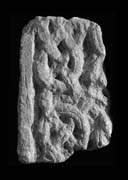
Object type: Part of cross-shaft
Measurements: H. 30.5 cm (12 in); W. 19.8 cm (7.8 in); D. 22 cm (8.6 in)
Stone type: Very pale orange (10YR 8/2), poorly sorted, sparry, matrix supported, oolite. Ooliths, most of which have fallen out to give an 'aero-chocolate' texture, range from 0.3 to 0.8 mm, but are mostly between 0.4 and 0.5 mm; they form about 60% of the rock. Shell fragments vary from sub-rounded (up to 0.8 mm) to platy bivalve fragments up to 3 mm across; they form between 5 and 10% of the rock. Cleeve Cloud Member, Birdlip Formation, Inferior Oolite Group, Jurassic. The nearest outcrop of Birdlip Limestone is some 35 km ESE.
Plate numbers in printed volume: Ills. 601-2
Corpus volume reference: Vol 10 p. 341-2
(There may be more views or larger images available for this item. Click on the thumbnail image to view.)
Shaft fragment, reused as building material (see above). 'Only two of its original surfaces were still visible, about half the width of the carved face and an unknown portion of one side' (Cracknell 1987–8, App. 3, microfiche G1). The present museum display, where the stone is 'built into' a suggested reconstruction of the cross, does not, unfortunately, allow face D to be observed or recorded. Face A of the stone is carved in quite high relief, with a plain square edge moulding. The carved face carries median-incised interlace in what is probably a mirror-image design of diagonal strands and simple looped knots (simple pattern F).
This cross is well carved and carefully laid-out, and the design, sometimes called the Carrick Bend (Cramp 1991, xxxii, fig. 23), would support a ninth-century date. Warwick is first mentioned in 914, when the Mercian Register records that ÆthelflÆd, Lady of the Mercians, established a burh there. However, it seems probable that there was already a minster of Middle Saxon origin at Warwick (Slater 1983; Bassett 2009). The findspot of this stone was not within the area of the medieval town on the north-west side of the River Avon, but in Bridge End which lies on the opposite bank of the river. It is possible that the stone originally formed part of a cross erected at the south-eastern end of a bridge or ford across the Avon. However, the principal church of Warwick's early minster complex (All Saints) was probably situated just across the Avon close to the river crossing (Bassett 2009, 140–2), and the most likely scenario is that the stone migrated across the Avon as building debris at some unknown date.
