Select a site alphabetically from the choices shown in the box below. Alternatively, browse sculptural examples using the Forward/Back buttons.
Chapters for this volume, along with copies of original in-text images, are available here.


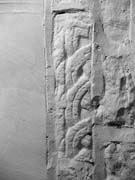
Object type: Cross-shaft fragment
Measurements: L. 41.5 cm (16.3 in); W. 10.8 > 9.8 cm ( 4.2 > 3.8 in); D. unknown
Stone type: Fairly hard, greyish pink to moderate orange pink (10R 8/2 to 10R 7/4), fine grained (0.15 to 0.25 mm) sandstone. Constituent grains mainly ?quartz and sub-angular to sub-rounded. Only a small area of the stone was visible through the removal of a small piece of later mortar above the stone. The grains were still obscured by the presence between them of white lime material. Probably a sandstone from within the Salop Formation, Warwickshire Group of Upper Carboniferous.
Plate numbers in printed volume: Ills. 560-1
Corpus volume reference: Vol 10 p. 313-4
(There may be more views or larger images available for this item. Click on the thumbnail image to view.)
The tower was built in the 1750s and the first floor originally opened through an arch to a gallery at the west end of the nave. The gallery was removed and the arch blocked during extensive alterations in 1887; the fragment was presumably discovered in the course of this restoration. The stone is described in the church guidebook as 'possibly Saxon' (Thomas 2003, 1) and was seen by Michael Hare in April 2010.
Fragment, probably part of a cross-shaft. The stone is carved with broad, rather irregular, median-incised interlace, with a pair of strands passing through free rings or looped elements. One edge of the stone survives with a wide-strand cable moulding. A second border along the left edge of the stone is so close to the terminal loop of the interlace, which bends sharply back on itself where it meets the border, that it should probably be seen as a jointing face between two sections of the original monument. The background of the carved area has been cut back c. 0.8 cm (0.3 in) leaving the strands of interlace in shallow relief.
This carving is probably half of the narrow face of a cross-shaft that was, almost certainly, made from more than one stone. Tantalisingly, not quite enough of the carving survives to allow for a definite reconstruction of the original design, but a series of free rings through which are woven the main strands of interlace seems to best fit the surviving evidence. This carving from Westbury contains design elements that can be found on several west Mercian carvings. Sharply pointed, median-incised interlace terminals together with looped or 'free' strands are found, for example, on a fragment of string-course from Deerhurst, Gloucestershire (Deerhurst St Mary 22, Ill. 214), dated to the ninth or tenth century. Pointed interlace terminals also occur, together with lozenge-shaped free rings and cabled edge mouldings, on a late tenth-/early eleventh-century cross-head fragment from Whitchurch, Warwickshire (Whitchurch 1, Ills. 603–6). However, the closest parallels for carvings that incorporate free rings in their designs come from beyond the immediate area. Examples of median-incised interlace with free rings occur in Cumberland (Workington 4, Brigham and Beckermet) and eastern Yorkshire (Sinnington). All are dated to the tenth or tenth/eleventh century (Bailey and Cramp 1988, 58–9, 75–6, 156, ills. 60, 61, 65, 75, 133, 137–40, 593–6; Lang 1991, 207–8, ill. 803). Similar combinations of design elements, plus cabled-edge mouldings, are found on the late tenth-/early eleventh-century Mid-Kesteven grave-covers from Lincolnshire and neighbouring counties (for example North Witham 1, Lincolnshire and Shelton, Nottinghamshire: Everson and Stocker 1999, 35–46, 239–40, ills. 316, 479). All these parallels are from the Scandinavian areas of settlement in the east and also to the north of Shropshire, and, if the Westbury design does contain free rings rather than looped elements, then it would seem reasonable to suggest that some degree of Scandinavian influence or inspiration can be seen in this carving. A date in the later tenth or early eleventh century is most likely.
Westbury had a large ancient parish comprising 14 townships (Gaydon 1968, 295–6). Two priests are mentioned in the Domesday Book entry (Thorn and Thorn 1986, no. 4,4,15). It is evident that Westbury was a minster church in the pre-Conquest period.
