Select a site alphabetically from the choices shown in the box below. Alternatively, browse sculptural examples using the Forward/Back buttons.
Chapters for this volume, along with copies of original in-text images, are available here.


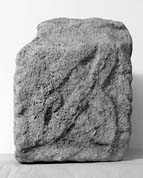
Object type: Lower arm of cross-head
Measurements: H. 23 cm (9 in); W. 21 < 23 cm (8.3 < 9 in); D. 18 < 20 cm (7 < 7.9 in)
Stone type: Very pale orange (10YR 8/2), very shelly, matrix-suported, poorly sorted, oolitic limestone. Ooliths, most of which have fallen out to give an 'aero-chocolate' texture, range from 0.3 to 0.6 mm, but are mostly between 0.5 and 0.6 mm diameter and form about 30% of the rock. Rounded to elongate shell fragments up to 15 mm across occur in layers and constitute about 50% of the rock. Gryphite Grit Member?, Aston Limestone Formation, Inferior Oolite Group, Middle Jurassic. The nearest outcrop of the Aston Limestone is south and west of Chipping Camden, some 12 km SW.
Plate numbers in printed volume: Ills. 603-7
Corpus volume reference: Vol 10 p. 342
(There may be more views or larger images available for this item. Click on the thumbnail image to view.)
The lower arm of a cross-head or the upper part of a sharply tapering shaft. The stone is rectangular in plan with a round drilled hole 3 cm (1.2 in) in diameter and 9 cm (3.5 in) deep in face F (bottom), presumably a fixing hole. There is a cabled edge-moulding and the carving on all faces is in shallow relief. The design seems to be the same on opposing faces A and C, and B and D.
A and C (broad): Face A shows a closed-circuit lozenge shape across which are laid a pair of diagonal, interlacing, straight-sided loops (turned pattern B). One of the lower returns on the diagonal loops is curved, while the other is more constrained by space and is angular. Face C is more worn but shows the lower half of the same motif. Both returns on the diagonal loops are sharply pointed.
B and D (narrow): Both faces carry a pair of diagonal, interlocked loops with box points. The complete motif looks rather like a Stafford knot or simple pattern B.
This small fragment is probably the lower arm of a C12-type cross-head (Cramp 1991, xvi, fig. 2), and it widens quite sharply upwards from the flat base in which there is a drilled fixing hole for jointing the head to the shaft. The fragment is difficult to date with certainty but the closed-circuit lozenge shapes on faces A and C are similar to the design on the face of a grave-cover from Bisley, Gloucestershire (no. 1, Ill. 45) for which a date in the first half of the eleventh century is proposed. A date in the late tenth or eleventh century would therefore seem appropriate for this piece.
