Select a site alphabetically from the choices shown in the box below. Alternatively, browse sculptural examples using the Forward/Back buttons.
Chapters for this volume, along with copies of original in-text images, are available here.


Object type: Grave-cover
Measurements: L. 46 cm (18 in); W. 37 > 31 cm (14.5 > 12.2 in); D. unknown
Stone type: Very pale orange (10YR 8/2), friable, shelly, matrix-supported, oolite. Ooliths, most of which have fallen out to give an 'aero-chocolate' texture, range from 0.3 to 0.5 mm, but are mostly between 0.4 and 0.5 mm; they form about 50% of the rock. Sub-rounded shell fragments up to 5 mm across form about 10% of the rock. Cleeve Cloud Member, Birdlip Formation, Inferior Oolite Group, Jurassic. The nearest outcrop of Birdlip Limestone is south and west of Chipping Camden, some 11 km SW. The geology of this stone is, therefore, different to Whitchurch 1 and 3, but there is not much difference in the distance to the nearest source (where the Aston Limestone sits on top of the Birdlip Limestone).
Plate numbers in printed volume: Ill. 608
Corpus volume reference: Vol 10 p. 343
(There may be more views or larger images available for this item. Click on the thumbnail image to view.)
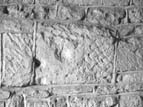
Panel with interlace, probably a grave-cover. There are deep diagonal axe or chisel cuts across the present upper part of the stone, the result of rough re-trimming for reuse. There is a 'U'-shaped cut in the left edge of the stone which is also probably a later reuse feature. Most of the left 'half' of the stone is plain, and, although there is a slight raised area towards the centre just above a shallow depression, much of the surface survives to the same height as that of the carved area. It seems probable, therefore, that this area of the stone only carried isolated motifs. On the slightly raised area there are faint traces of two curving strands of interlace, and it is possible that this might originally have been a low, interlace-covered boss. On the other 'half' of the stone there is a panel of rather ragged, median-incised interlace. The interlace has a clear edge on the left and has been cut away on the right leaving a carved area 17 cm (6.5 in) wide.
The interlace panel is quite well laid out but rather crudely executed, suggesting that this is perhaps a locally produced grave-cover. The site is called Witecerce in Domesday Book and there is reference to a priest, but there are no remains of Anglo-Saxon fabric in the present building (Morris 1976, no. 16,21; Hingley et al. 1995, 66–7). However, the presence of fragments of three different tenth- or early eleventh-century carvings, two that are probably gravestones and the other a cross or cross-head, is a clear indication of a church on or very close to this isolated site by the tenth century.
