Select a site alphabetically from the choices shown in the box below. Alternatively, browse sculptural examples using the Forward/Back buttons.
Chapters for this volume, along with copies of original in-text images, are available here.


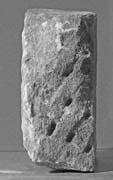
Object type: Fragment probably from a grave-cover
Measurements: H. 21 cm (8.3 in); W. 10 cm (3.9 in); D. 21 cm (8.3 in)
Stone type: Very pale orange (10YR 8/2), shelly, matrix-supported, poorly sorted oolitic limestone. Ooliths, most of which have fallen out to give an 'aero-chocolate' texture, range from 0.3 to 0.7 mm, but are mostly between 0.5 and 0.6 mm diameter and form about 45% of the rock; they are set in a sparry matrix. Rounded to elongate shell fragments up to 7 mm across occur in layers and constitute between 25% of the rock in the less shelly beds, up to about 50% of the rock in the shelly concentrations. Shell fragments consist of bivalves, small gastropods and common cidarid spines. Gryphite Grit Member?, Aston Limestone Formation, Inferior Oolite Group, Middle Jurassic. The nearest outcrop of the Aston Limestone is south and west of Chipping Camden, some 12 km SW.
Plate numbers in printed volume: Ills. 609-14
Corpus volume reference: Vol 10 p. 343-4
(There may be more views or larger images available for this item. Click on the thumbnail image to view.)
Small block, probably originally part of a grave-cover, reused initially as a hood-moulding. Part of an interlace design survives on one edge of the stone. The ornament is unusual and consists of at least five broad, concentric curving strands of plain interlace crossing four strands that are fanning out slightly. There is one small surviving narrow section of a border down one side.
The plain rather than median-incised interlace on this carved fragment, and the unusual pattern, indicates that this is unlikely to be part of no. 2 from this church. However, the scale of the interlace suggests that it was part of a large design, perhaps from a second grave-cover with bold, sweeping, interlocking curves across at least part of its face. This stone has been reused twice, first as part of a chamfered hood-moulding and then probably as part of the plinth of the Norman west wall. This double reuse is an indication of a remarkable amount of activity during the tenth- to twelfth-century period at this small isolated church.
