Select a site alphabetically from the choices shown in the box below. Alternatively, browse sculptural examples using the Forward/Back buttons.
Chapters for this volume, along with copies of original in-text images, are available here.


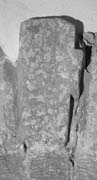
Object type: Cross-carved keystone
Measurements:
Keystone: H. 34.2 cm (13.5 in); W. 20 > 14 cm (7.9 > 5.5 in); D. 39 cm (15.3 in) to crack in soffit face of arch, but probably originally a through-stone c. 75 cm (29.5 in) in depth.
Cross-shaft: W. 18.3 > 13 cm (7.2 > 5.1 in); northern cross-arm: H. 12 cm (4.7 in); W. 3 > 2.8 cm (1.2 > 1.1 in); the face of the cross projects from the face of the arch by 3.6 cm (1.4 in) on the south and 3 cm (1.2 in) on the north side.
Stone type: Yellowish oolitic limestone.
Plate numbers in printed volume: Ills. 615-6
Corpus volume reference: Vol 10 p. 344-5
(There may be more views or larger images available for this item. Click on the thumbnail image to view.)
The keystone of the arch projects eastwards from the face of the arch and has been cut back into the shape of a simple cross with a broad, tapering body and very short arms. Only the northern arm survives but there is a scar for the missing southern arm. The northern end of the cross-arm is slightly concave. The face of the cross has been roughly tooled, and the surface is covered with small patches of the limewash that covered the plastered surface of the whole wall until 1985 (Bassett 1985a, 9).[1]
Bassett established that this cross-carved keystone is an integral part of the chancel arch, one of four arches in the crossing at the base of the central tower (Bassett 1986, 7–9, fig. 4, pl. 2). The tower itself is Anglo-Saxon, with Bassett believing it more likely to be tenth century in date rather than early eleventh century, as suggested by Fernie and by Taylor and Taylor (Taylor and Taylor 1965, ii, 685; Fernie 1983, 178; Bassett 1985a, 13–14). Plaster stripping showed a crack rising through the east face of the tower wall, and this disturbance has damaged the arch, splitting the upper through-stone voussoirs in two. Some of the stonework immediately above the arch may be part of the repair work required to stabilise the wall and relieve some of the pressure on the arch. The north side of the arch bears signs of what may be a cut-back hood-moulding, but there is little evidence for the continuation of this hood-moulding on the south side. If completed, the hood-moulding would have passed across the top of the cross-arms, with the cross-head intruding up across the width of the hood-moulding.
This is a very simple carving, but it would have offered an obvious visual focus to a priest celebrating at the altar in the small chancel or for clergy seated around the east end looking westwards towards an altar at the crossing (Bassett pers. comm.). It has, however, proved quite difficult to find exact parallels. There are crosses carved in shallow relief in the middle of the curved window-heads in the south face of the tower at Earls Barton, Northamptonshire (Clapham 1930, pl. 40; Taylor and Taylor 1965, i, 224–5, fig. 100). Coventry 2 is also similar: that panel carries an arch with three concentric mouldings in relief above a semi-circular opening, although in this case the cross stands on top of the arch moulding (p. 338, Ill. 589). A similar, shallow-relief cross was noted at Limpley Stoke, Wiltshire on a reused slab that may have been a lintel (Cramp 2006, 220–1, ill. 462).
The closest parallel is surely the foliated cross set at the centre of a fictive arch above Christ in Majesty in the Trinity Gospels (first quarter eleventh century) (Cambridge, Trinity College, MS B.10.4, fol. 16b: Backhouse et al. 1984, 68, cat. 49, col. pl. XIII). The illumination at the beginning of Psalm 119 in the late tenth-century Salisbury Psalter offers a different treatment of the same subject. Here the figure of Christ, standing on the top of a large initial letter 'A', rises in front of a fictive arch to act visually as the keystone (Salisbury, Cathedral Lib., MS 150, fol. 122: Backhouse et al. 1984, 50–1, cat. and ill. 29).
It is more common to set roundels (paterae) at the centre of borders and the apexes of fictive arches in Anglo-Saxon manuscripts, and this may be a related convention. Examples can be found in the later ninth-century Benedictional of St Æthelwold (British Library, Add. MS 49598, fols. 34v, 35, 56v, 57, 67v, 68, 102v, 103, 108: Temple 1976, 49–53, cat. 23; Prescott 2002); the late ninth-century Benedictional of Archbishop Robert (Rouen, Bib. Municipale, MS Y.7 (369), fols. 29v, 54v: Temple 1976, 53–4, cat. 24, frontispiece and ill. 87); and on a canon table in the early eleventh-century Bury Gospels (British Library, Harley MS 76, fol. 8v: Temple 1976, 93, cat. 75, ill. 230; Backhouse et al. 1984, 74, cat. 58). The ninth-century carving of the Virgin and Child at Deerhurst, Gloucestershire (Deerhurst St Mary 5, Ills. 147–8) also carries a patera in this position. The two roundels noted above from the Benedictional of Archbishop Robert carry the Hand of God. The roundels from the Bury Gospels canon table are filled with broad leaves in the form of crosses, while several of the roundels in the Benedictional of St Æthelwold carry crosses that burst out of their constraining borders into profusions of luxurious leaves. The patera on the arch above the Virgin and Child carving at Deerhurst is still outlined with traces of red paint (Gem et al. 2008, 141–2, figs. 46, 47). Perhaps this also once carried a painted cross.
A charter, granting 20 hides of land at Wootton Wawen in the region known as Stoppingas, was issued by King Æthelbald of Mercia between 716 and 737 to Æthelric, a member of the royal dynasty of the Hwicce (Sawyer 1968, no. 94); the wording of the charter suggests that the purpose of the grant was the establishment of a minster. The minster was in the hands of the bishop of Worcester by the 840s, but its history in the late Saxon period is obscure (Sims-Williams 1990, 149–50; Bassett 2006; Tinti 2010, 194–5); by the reign of Edward the Confessor, Wootton Wawen was probably the principal estate of Vagn, a prominent member of the household of Earl Leofric of Mercia (Baxter 2007, 241–2). The extent and subsequent development of the minster parish has been established by Steven Bassett (2006).
