Select a site alphabetically from the choices shown in the box below. Alternatively, browse sculptural examples using the Forward/Back buttons.
Chapters for this volume, along with copies of original in-text images, are available here.


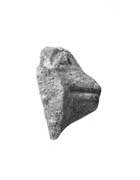
Object type: Part of animal head
Measurements: H. 4 cm (1.6 in); W. 4 cm (1.6 in); D. 2.5 cm (1 in)
Stone type: Very pale orange (10YR 8/2), grain supported, slightly shelly oolite with a sparry matrix. Few hollow grains. Oolith size 0.1 to 0.5 mm. Shell debris size 2–3 mm. Cleeve Cloud Member, Birdlip Limestone Formation, Inferior Oolite Group, Middle Jurassic.
Plate numbers in printed volume: Ills. 668-71
Corpus volume reference: Vol 10 p. 367-8
(There may be more views or larger images available for this item. Click on the thumbnail image to view.)
Small animal head. There is incised outlining on the eyebrows and around the eyes and nostrils. The pupils are drilled. The mouth is wide with traces of red paint. There are faint ridges carved in the snout.
This fragment is clearly no more than a small part of a much larger carving, perhaps a screen or shrine. Sally Crawford (Crawford 2000) notes that drilled eyes occur on Mercian sculpture from as early as the late eighth/ninth century, but the Worcester head does not carry any other early features, such as the curling eyebrow ridges and tear-drop eyes found on animal heads at, for example, Deerhurst (Gloucestershire) in the first half of the ninth century (see Ill. 180). Instead, Crawford draws attention to the close similarity of the Worcester creature's face with its 'snub nose, elongated mouth and lack of chin' to that of one of a pair of creatures on an eleventh-century cross-shaft fragment from Southampton (Tweddle et al. 1995, 264–5, ills. 459–60). Crawford also draws attention to similar creatures in an eleventh-century manuscript of the Anglo-Saxon illustrated Hexateuch (British Library, Cotton MS Claudius B. IV, fol. 14: Backhouse et al. 1984, 153, cat. 157, col. pl. XXX), and a late tenth-century parallel from the top of a capital 'A' on fol.122 of the Salisbury Psalter (Salisbury, Cathedral Library, MS 150: Backhouse et al. 1984, 50–1, cat. and ill. 29). Indeed this last is so similar that it would seem reasonable to extend the date range for this piece to late tenth/mid eleventh century. The wide-mouthed head in the centre of an initial 'B' on fol. 4 of the late tenth-century Ramsey Psalter would further support this suggestion (British Library, Harley MS 2904: Backhouse et al. 1984, 60, cat. 41, col. pl. IX), as would similar animal heads in a copy of Aldhelm's De virginitate (Cambridge, Corpus Christi MS 326: Budny 1997, 245–52, cat. 21, ills. 194, 196).
Worcester Cathedral was established by 680. A substantial quantity of material has survived from the cathedral's archives, and no adequate summary can be provided here. A useful short summary is provided by Barrow 1999; see also Chapter II above, passim; Sims-Williams 1990; Brooks and Cubitt 1996; Barrow 2004; Barrow and Brooks 2005; Tinti 2010. For the two principal pre-Conquest churches of St Peter and St Mary, see Chapter II, p. 17; Dyer 1968–9; Tinti 2010, 31–3, 269–70; these two churches were demolished in the course of the construction of the new Romanesque cathedral begun by Bishop Wulfstan II in 1084. In addition to the two principal churches, there was also a chapel of St Michael, probably a mortuary chapel (Barrow 2004, 149–51).
