Select a site alphabetically from the choices shown in the box below. Alternatively, browse sculptural examples using the Forward/Back buttons.
Chapters for this volume, along with copies of original in-text images, are available here.


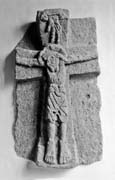
Object type: Crucifixion panel
Measurements: H. 86.5 cm (34 in); W. 48.5 > 46.5 cm (19 > 18.3 in); D. (visible) 14 > 9 cm (5.5 > 3.5 in)
Stone type: Greyish orange (10YR 7/4), poorly sorted, clast-supported, coarse, shelly limestone. Shell fragments range from 0.3 to 15 mm and appear to dominantly bivalves, but also include bryozoa. There are only a few ooliths (or very well-rounded shell fragments) ranging from 0.4 to 0.6 mm. Non-oolitic limestones are rare in the Inferior Oolite. Almost certainly, this piece can be referred to the Aston Limestone Formation, but refining the stratigraphical horizon is difficult. The presence of common bryozoa could be diagnostic locally and have been noted in slabs of similar limestone forming steps of stiles on the Cotswold Way. Wethered (1871) refers to common polyzoa (= bryozoa) in the Gryphite Grit. From descriptions in Barron et al. (2002), the Gryphite Grit Member seems a likely candidate for the Crucifixion panel, but as yet, we have not seen this lithology in the field. Gryphite Grit Member?, Aston Limestone Formation, Inferior Oolite Group, Middle Jurassic. The nearest outcrop of the Aston Limestone is 5 km south-east.
Plate numbers in printed volume: Ills. 447-8; Fig. 31C
Corpus volume reference: Vol 10 p. 251-3
(There may be more views or larger images available for this item. Click on the thumbnail image to view.)
This stone is reported to have been 'dug up in the garden of Wormington Grange about four years ago, and was fixed in the east wall of the south aisle of the church of St Catherine at Wormington, by the late Mr. R. E. S. Thomas, the discoverer' (Dixon 1916, 70; see also Humphreys 1917, 9; (—) 1924a). The discovery must therefore have taken place c. 1912. Mr Thomas was the then occupier of Wormington Grange; he was still alive in March 1913 (Gloucestershire Archives, P378 VE 2/2).
Crucifixion panel carved in high relief. The arms and shaft of the cross are wedge-shaped. The ends of both cross-arms are missing as are the hands of Christ, suggesting that this crucifixion was either originally carved on at least three panels or that the original panel was much wider and has been cut down. Christ's haloed head is sagging onto his chest as he comes near to the end. His head is turned to his right and a long strand of hair, tucked behind his ear, falls across his left shoulder. He has high eyebrows above rather bulbous eyes. The end of his nose is now broken off. He has a long and luxurious moustache and a forked beard that is carved full frontal rather than in half profile like the rest of the face. Taylor and Taylor misinterpreted this last feature (perhaps from a photograph) and suggested, incorrectly, that the forked beard should be seen as the jaws of a Lamb's head carved in profile (Taylor and Taylor 1966, 13–15, fig. 5). Christ's arms are long and thin, the right arm being slightly flexed and the left straight, while his legs are well modelled. His body is wrapped in a heavily folded loin-cloth that is tied around his waist with an elaborately knotted double cord. Coatsworth felt that the loin-cloth was itself 'folded over at the waist, with one end of the garment tucked under the fold to appear again above' (Coatsworth 1988, 178). The upper part of Christ's body is quite small, but the feet, resting on a sloping plinth or suppedaneum, are huge and the ankle bones are very pronounced. Again Coatsworth has suggested that one of the ankle bones on the left foot is in fact a rounded nail-head. Across the top arm of the cross, the Hand of God reaches down from a cloud to touch the top of Christ's cruciferous halo. Coatsworth draws attention to the fact that the Hand of God is 'held palm outwards with the little finger and third finger curled into the palm, a gesture of Benediction' and shows this blessing gesture to be a feature of the late pre-Conquest iconography of the crucifixion (see below).
The Wormington Christ is full of character and displays exaggerated features, similar to several figures from Daglingworth in Gloucestershire (nos. 1–4, Ills. 100–6) and the Virgin and Child from Inglesham in north Wiltshire (Cramp 2006, 217–19, ills. 453–4). It is suggested elsewhere that all these carvings might be the work of one carver who used exaggeration to create emphasis (Chapter III, p. 27). The Wormington carving is not very large, but when one looks up at it, the large feet seem to be much nearer that the rest of the body, and the effect is to raise Christ to an even higher plane far above the viewer. Casson proposed a ninth-century date for this piece but this seems to be much too early (Casson 1933, 31–2, pl. IId). Talbot Rice identified the suffering that is clearly portrayed on the Wormington Christ as an example of Syrian or Palestinian influence that acknowledged the humanity of Christ rather than treating him as 'a figure of heavenly glory whom pain could not touch' (Rice 1952a, 85, 98–9, pl. 11b). Rice believed that this eastern tradition was particularly influential in Ireland and France and that it could be seen on other Anglo-Saxon carvings, for example the tenth- to eleventh-century crucifixion reset externally over the porch at Langford in Oxfordshire (Tweddle et al. 1995, 213, ills. 292–3). Rice suggested a date for the Wormington crucifixion between 1020 and 1050. Beckwith compares the Wormington carving to the figure of Christ on a bone pectoral cross that he dates to the late tenth or early eleventh century (Beckwith 1972, 52, 125, cat. 35, ill. 70). Coatsworth (1988, 178–9) gives late tenth- to first half eleventh-century parallels in ivory carving and manuscript painting. In particular she offers the example of 'an unfinished drawing of the crucified Christ on a text page of a manuscript copy of Bede's Historia Ecclesiastica, an unprovenanced manuscript dated to the first half of the eleventh century (Cambridge, Corpus Christi College 41, p. 484: Temple 1976, 98–9, cat. 81, ill. 255; Budny 1997, 523, pl. 442). This drawing is indeed similar to the Wormington figure, with the head twisted to the right, a forked beard, long hair tucked behind the left ear before falling across the left shoulder, and the heavily folded loin cloth looped up back on itself at the waist (see this volume, Ill. 795). However, in view of the suggested links with the carvings from Daglingworth and Inglesham (see above), the present writer favours the rather broader date range of late tenth to mid-eleventh century for the Wormington carving.
It has often been suggested that this crucifixion may have come from Winchcombe Abbey (which is just under 7 km to the south). This suggestion is probably based on the fact that two coffins excavated at Winchcombe in 1815 were taken to Wormington Grange for a long period in the nineteenth century before being returned to Winchcombe (see the Appendix B entry in respect of Winchcombe, below, p. 271). It is hard to see why a sculpture from Winchcombe Abbey should be taken to Wormington Grange only to be buried on arrival (whether in the sixteenth or in the nineteenth century); however, it is possible that the stone was found by Mr Thomas (who was a keen gardener) among the remains of a rockery created by the Gist family in the nineteenth century.[1] Another possibility also deserves attention. Wormington Grange, where this carving was discovered, was not in the parish of Wormington. The tithe award of 1847 (Gloucestershire Archives, GDR/T1/68) shows Wormington Grange as a substantial detached portion of the parish of Didbrook; this situation seems likely to have arisen due to the ownership of both Didbrook and Wormington Grange by the nearby Cistercian abbey of Hailes. Documents of 1621 and 1657 make it clear that Wormington Grange was also known as Wormington Magna or Great Wormington (Gloucestershire Archives, D892/T22/1). This seems likely to imply that there was once a village at or near the site of Wormington Grange, and it is indeed thought to be the site of a deserted medieval village (Beresford and Hurst 1971, 188, where Wormingon Grange is, however, mistakenly considered to be the site of Wormington Parva, which in fact survives as the existing village of Wormington). There are now no earthworks of a deserted settlement at Wormington Grange, but the grounds have been extensively landscaped in recent centuries (Gloucestershire Sites and Monuments Record, areas 2300 and 22384). No reference to a medieval church or chapel at Wormington Magna has yet been traced, but documents of 1657 (as above) do refer to a 'Chappell Close', and this would seem to imply the likelihood that a medieval place of worship had once existed. Given the good condition of the carving, the most likely scenario would seem to be that the carving was deliberately buried during an episode of desertion; it was perhaps a treasured feature of the lost church of Great Wormington. There is a late medieval font of unknown provenance (but identical to the font at Woolstone 6 miles to the south-west) in the garden at Wormington Grange, and this font may also come from the former church of Great Wormington.
