Select a site alphabetically from the choices shown in the box below. Alternatively, browse sculptural examples using the Forward/Back buttons.
Chapters for this volume, along with copies of original in-text images, are available here.


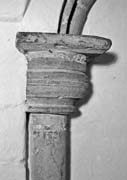
Object type: Twenty-four capitals and bases
Measurements:
The numbering below runs from the west end of the north arcade, beginning with the capitals, then the bases (again starting from the west), and finally the bases in the south arcade (starting from the west).
North 'capitals'
3a: H. 20 cm (7.9 in); W. 24 cm (9.4 in); D. 22 cm (8.6 in)
3b: H. 20 cm (7.9 in); W. 27 cm (10.6 in); D. 20 cm (7.9 in)
3c: H. 21 cm (8.3 in); W. 28 cm (11 in); D. 20 cm (7.9 in)
3d: H. 20 cm (7.9 in); W. 20 cm (7.9 in); D. 20 cm (7.9 in)
3e: H. 16 cm (6.3 in); W. 20 cm (7.9 in); D. 20 cm (7.9 in)
3f: H. 19 cm (7.5 in); W. 28 cm (11 in); D. 20 cm (7.9 in)
3g: H. 18 cm (7 in); W. 27 cm (10.6 in); D. 20 cm (7.9 in)
3h: H. 18 cm (7 in); W. 21 cm (8.3 in); D. 20 cm (7.9 in)
North 'bases'
3i: H. 22 cm (8.6 in); W. 20 cm (7.9 in); D. 16 cm (6.3 in)
3j: H. 19 cm (7.5 in); W. 26 cm (10.2 in); D. 19 cm (7.5 in)
3k: H. 19 cm (7.5 in); W. 27 cm (10.6 in); D. 21 cm (8.3 in)
3l: H. 19 cm (7.5 in); W. 20 cm (7.9 in); D. 19 cm (7.5 in)
3m: H. 17 cm (6.7 in); W. 19 cm (7.5 in); D. 18 cm (7 in)
3n: H. 19 cm (7.5 in); W. 29 cm (11.4 in); D. 21 cm (8.3 in)
3o: H. 20 cm (7.9 in); W. 29 cm (11.4 in); D. 21 cm (8.3 in)
3p: H. 18 cm (7 in); W. 20 cm (7.9 in); D. 16 cm (6.3 in)
South 'bases'
3q: H. 19 cm (7.5 in); W. 21 cm (8.3 in); D. 20 cm (7.9 in)
3r: H. 19 cm (7.5 in); W. 27 cm (10.6 in); D. 21 cm (8.3 in)
3s: H. 10 cm (3.9 in); W. 27 cm (10.6 in); D. 21 cm (8.3 in)
3t: H. 20 cm (7.9 in); W. 21 cm (8.3 in); D. 19 cm (7.5 in)
3u: H. 19 cm (7.5 in); W. 20 cm (7.9 in); D. 17 cm (6.7 in)
3v: H. 17 cm (6.7 in); W. 28 cm (11 in); D. 21 cm (8.3 in)
3w: H. 20 cm (7.9 in); W. 28 cm (11 in); D. 21 cm (8.3 in)
3x: H. 11 cm (4.3 in); W. 23 cm (9 in); D. 17 cm (6.7 in)
Stone type:
North 'capitals'
3a: Greyish orange (10YR 7/4) grain supported oolite with sparry matrix. Some hollow grains. Oolith size 0.3 to 0.8 mm but mainly around 0.6 mm. Sparse shell content. Cleeve Cloud Member, Birdlip Limestone Formation, Inferior Oolite Group, Middle Jurassic.
3b: Greyish orange (10YR 7/4) grain supported oolite with sparry matrix. Fairly shelly. Oolith grain size mainly around 0.6 mm. Shell debris 3–4 mm. Cleeve Cloud Member (as 3a).
3c: Greyish orange (10YR 7/4) grain supported slightly shelly oolite with sparry matrix. Some hollow ooliths. Grain size 0.4 to 1.0 mm. Shell debris 2–4 mm. Cleeve Cloud Member (as 3a).
3d: Greyish orange (10YR 7/4) grain supported slightly shelly oolite with sparry matrix. Oolith size 200–600µm. Surface somewhat obscured probably by old paint. Cleeve Cloud Member (as 3a).
3e: Greyish orange (10YR 7/4) grain supported oolite with sparry matrix. Oolith size 0.4 to 0.6 mm. Cleeve Cloud Member (as 3a).
3f: Greyish orange (10YR 7/4) grain supported slightly shelly oolite with sparry matrix. Grain size 0.4 to 0.8 mm. Some shell debris. Cleeve Cloud Member (as 3a).
3g: Greyish orange (10YR 7/4) grain supported oolite with sparry matrix. Shelly in top part of capital. Oolith size 0.5 to 0.8 mm. Shell debris 3–4 mm. Cleeve Cloud Member (as 3a).
3h: Greyish orange (10YR 7/4) grain supported slightly shelly oolite with sparry matrix. Ooliths 0.5 to 0.8 mm. Cleeve Cloud Member (as 3a).
North 'bases'
3i: Grain supported slightly shelly oolite with sparry matrix. Grain size 0.3 to 0.8 mm. Geology heavily obscured by old paint. Cleeve Cloud Member (as 3a).
3j: Yellowish greyish (5Y 8/1) grain supported slightly shelly oolite with ? sparry matrix. Ooliths c. 0.6 mm A few shell fragments (2–3 mm). Very heavily obscured by paint. Cleeve Cloud Member (as 3a).
3k: Oolite?, sparry? Grain supported. c. 0.5 mm. Very heavily obscured by paint. Possibly Cleeve Cloud Member (as 3a).
3l: Yellowish greyish (5Y 8/1) grain supported oolite with sparry matrix. Oolith size 0.5 to 0.8 mm. Largely obscured by paint. Possibly Cleeve Cloud Member (as 3a).
3m: Oolite with ?sparry matrix ?grain supported. Ooliths 0.4 to 0.8 mm in size. Very heavily obscured by old paint. Possibly Cleeve Cloud Member (as 3a).
3n: Yellowish grey (5Y/8/1) oolite with sparry matrix with a little shell debris. Ooliths c. 0.5 mm. Very heavily obscured by old paint. Possibly Cleeve Cloud Member (as 3a).
3o: Yellowish grey (5Y/8/1) oolite, grain supported with sparry matrix and a little shell debris. Ooliths 0.5 to 0.8 mm. Shell debris 2–3 mm. Very heavily obscured by old paint. Possibly Cleeve Cloud Member (as 3a).
3p: Yellowish grey (5Y/8/1) oolite, grain supported with sparry matrix and a little shell debris. Ooliths 0.5 to 0.8 mm. Very heavily obscured by old paint. Possibly Cleeve Cloud Member (as 3a).
South 'bases'
3q: Oolite, sparry, grain supported with a little shell debris. Ooliths c. 0.6 mm. Shell debris 2–3 mm. Almost completely obscured by old paint. Possibly Cleeve Cloud Member (as 3a).
3r: ?Sparry oolite. Due to old paint cover almost nothing to be seen of geology. Possibly Cleeve Cloud Member (as 3a).
3s: Moderate reddish brown to reddish orange (10R 5/6) very fine-grained, well-sorted sandstone. Grains mainly sub angular and between 0.1 to 0.15 mm in size. Possibly Old Red Sandstone, Lower Devonian.
3t: Oolite, ?sparry matrix supported. Some hollow oolith (0.3 to 1.0 mm). Small amount of shell debris. Heavily obscured by old paint. Possibly Cleeve Cloud Member (as 3a).
3u: As in no. 3r above. Very heavily obscured by old paint. Possibly Cleeve Cloud Member (as 3a).
3v: Oolite, shelly, sparry matrix supported. Oolith size 0.6 to 1.0 mm. Shell debris 2–3 mm. Very heavily obscured by old paint. Possibly Cleeve Cloud Member (as 3a).
3w: Very heavily obscured by old paint. Possibly Cleeve Cloud Member (as 3a).
3x: Inaccessible because of heavy catering equipment but almost certainly oolite. Possibly Cleeve Cloud Member (as 3a).
Plate numbers in printed volume: Ills. 677-701; Figs. 21F-J
Corpus volume reference: Vol 10 p. 369-71
(There may be more views or larger images available for this item. Click on the thumbnail image to view.)
A group of twenty-four capitals and bases, all of which seem to be lathe-turned, that have been reused in the Norman slype (Ill. 701). In the north arcade all the capitals and bases are reused, while in the south arcade reused bases are used together with newly carved capitals that are very similar to those in Wulfstan's crypt. The attached shafts (14 < 15 cm (5.5 < 5.9 in) in diameter) are also reused, and the arches of the blind arcading are 'made up of small re-used voussoirs crudely put together' (Barker and Romain 2001, 30–1). In the north arcade, Capitals 3b and 3d were probably originally bases (Ills. 678, 680), while Bases 3i, 3m and 3p were probably originally capitals (Ills. 685, 689, 692) as was Base 3t on the southern arcade (Ill. 696). If these assumptions are correct, there are ten capitals and fourteen bases in this assembly. The capitals range in height from 16 < 21 cm (6.3 < 8.3 in), and in profile they are conical or slightly bow-sided with a sharp in-turn above the collar. The surface of each of the capitals is covered with wide horizontal bands separated by narrow, sometimes raised mouldings. On Capital 3c, two of the wide bands are further decorated with median-incised double lines (Ill. 679), while on Capital 3a the lowest wide band carries close-set vertical inscribed lines (Ill. 677). The bases are bulbous, either round or sagging in profile. The surfaces are either plain or carry single or double inscribed horizontal lines. One of the bases in the south arcade (Base 3s, Ill. 695) has a very different profile, is only 10 cm (3.9 in) high (rather than the 19 < 20 cm (7.5 < 7.9 in) of all but one of the others) and is made of red sandstone rather than oolitic limestone. This base is probably Roman.
It should be noted that among the many manuscript illustrations that show similar capitals and bases, several show bulbous capitals, and two (fols. 99v and 118v) from the tenth-century Benedictional of St Æthelwold show them used the other way round with bulbous capitals and conical bases (Temple 1976, 49–52, cat. 23, ill. 91; Prescott 2002, fols. 99v, 118v). It is, therefore, possible that this was the way they were originally set at Worcester.
A carved parallel for the forms of the Worcester capitals and bases can be found in the reused baluster shafts with integral capitals and bases at St Albans, Hertfordshire; these are dated by Biddle and Kjølbye-Biddle to the tenth century or earlier (Tweddle et al. 1995, 236–40, ills. 376–96). The decoration and shape of several of the Worcester pieces is also similar to some of the lathe-turned late tenth-century fragments recovered during excavations on the Old Minster site in Winchester, Hampshire (ibid., 280–5, ills. 514–20, 523–4, 527–35). Another example is a capital found in excavations at Lancaster Castle (Potts and Shirras 2002, 6–7, figs. 1a, 1b; Bailey 2010, 230, ills. 623, 624). The mouldings on Worcester Cathedral Capital 3c (Ill. 679) are rather similar to the mid-shaft mouldings from one of the baluster shaft fragments (M.42) found during excavations at St Edmund's Abbey, Suffolk, and dated to the first half of the eleventh century (Gem and Keen 1981, 8, fig. 4). However, the rest of the Worcester Cathedral capitals are rounder in profile with much less pronounced mouldings, and the bulbous Worcester bases are even more distinct with little or no surface decoration. It seems probable that the moulded balusters from St Edmund's Abbey should be seen as a later development of the Worcester style.
The whole reused Worcester assembly presumably came from one of the Anglo-Saxon cathedral churches, St Mary's or St Peter's, demolished in or shortly after 1084 to make way for Wulfstan's new cathedral church. St Mary's was started in the 960s by Bishop Oswald and completed by 983. St Peter's was the ancient cathedral first established in the seventh century; it was still standing in 991, while the presbytery was enlarged in stone during the reign of Edward the Confessor (1042–66) (Barker and Romain 2001, 4–5; Tinti 2010, 32). The tenth-century sculpture and manuscript parallels discussed above suggest that the Worcester capitals and bases would also be most 'at home' in the tenth century and that they therefore came in all likelihood from St Mary's.
