Select a site alphabetically from the choices shown in the box below. Alternatively, browse sculptural examples using the Forward/Back buttons.
Chapters for this volume, along with copies of original in-text images, are available here.


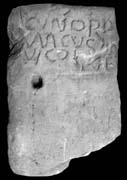
Object type: Inscription: 'Cunorix Stone'
Measurements: H. 69 cm (27.1 in); W. 46 cm (18 in); D. 15 cm (5.9 in)
Stone type: Sandstone, friable, fine- to medium-grained (0.2 to 0.4 mm), moderate orange pink to pale reddish brown (10YR 7/4 to 10YR 5/4). Grains dominantly quartz with subordinate feldspar and mica. Quartz grains sub-angular to sub-rounded. Bedding appears to be parallel to slab. Bromsgrove Sandstone Formation, Sherwood Sandstone Group, middle Triassic.Sandstone, friable, fine- to medium-grained (0.2 to 0.4 mm), moderate orange pink to pale reddish brown (10YR 7/4 to 10YR 5/4). Grains dominantly quartz with subordinate feldspar and mica. Quartz grains sub-angular to sub-rounded. Bedding appears to be parallel to slab. Bromsgrove Sandstone Formation, Sherwood Sandstone Group, middle Triassic.
Plate numbers in printed volume: Ill. 571
Corpus volume reference: Vol 10 p. 318-9
(There may be more views or larger images available for this item. Click on the thumbnail image to view.)
Found 'in the early spring of 1967 in ploughing just inside the defences of the Roman town at Wroxeter (Viroconium), just west of the "Eastern Cemetery"'; the site of discovery is stated to be 'about 575 yards north-east of the north-east angle of the Forum'. The stone was initially taken to the home of Dr A. W. J. Houghton of Pulverbatch (Wright and Jackson 1968, 296).
This is probably a reused fragment (the upper left corner) of a Roman inscription or tombstone, although no trace of the earlier text survives. The stone carries a three-line inscription to Cunorix, an Irishman. The inscription is cut (pecked) into a raised moulding which probably formed a border (subsequently trimmed back) around a recessed panel on the original Roman monument. A small, slightly oval (c. 4.5 x 5.4 cm (1.8 x 2.1 in)), round-bottomed hole has been cut into the top left corner of the recessed area. The stone was already weathered before the inscription was added. The zone containing the inscription is about 27 cm (10.6 in) high. Wright and Jackson noted that '[the] three lines of lettering had been pecked in the manner of quarry-inscriptions [like R.I.B. 1009]'. There is some surface damage to the text, and a little of the right-hand edge has been lost, but it appears legible with only a few letters noted as questionable (Wright and Jackson 1968, 297).
Inscription: CVNORIX | MACVSMA | [Q]VICO[L]I[N]E
Expansion: CVNORIX MACVS MAQVI COLINE
Translation: 'Cunorix, son of Maqqas-Coline'
For comments on the palaeography, see Wright and Jackson 1968, 297 n.1, 299; Tedeschi 2005, 32, 39, 222–3; Charles-Edwards in Redknap and Lewis 2007, 538. Various parallels can be drawn with Insular inscriptions of the fifth and earlier sixth centuries. Charles-Edwards describes the letter-forms as 'Coarse Roman capitals, informal and cursive'.
The use of MACVS 'son', and its genitival equivalent MAQVI?, immediately establish this as a text with Irish affiliations. Presumably the two men mentioned were Irishmen, though the name of the commemorated son appears British in form, perhaps because either he or the inscriber had assimilated it to local usage. In the early Middle Ages Irish and Welsh were still closely similar in many respects, and both later languages preserved forms of this early Celtic personal name (Cunorix, literally 'hound-king' > Welsh Cynyr, Irish Conri). The name of the father is more characteristically Irish, (1) because of the form of MAQVI, with Irish q where Brittonic languages had developed p, and (2) because this type of compound name, using 'son of' perhaps to mean something like 'of the nature of' (in this case 'of the nature of holly'), is common in Ireland and not productive in Welsh. The stone's MAQVICOLINE can be normalised in the nominative as Maqqas-Coline, later Irish Macc-Cuilinn; and in the genitive as Maqqi-Coline, later Irish Maicc-Chuilinn.
Commentators have discussed various linguistic points which may be relevant to dating the inscription. These calculations are greatly complicated, not only by the potential influence of British on Irish, but also by interference from Latin, and by the possibility that the carver worked in a conservative or even archaizing tradition. For the details see Wright and Jackson 1968, 297–300; McManus 1997, 76–7; Sims-Williams 2003, 26, 333–4; Tedeschi 2005, 222–3; Sims-Williams in Redknap and Lewis 2007, 538–9. The latter concludes that two potentially late features (C, not Q, in MACVS, and final ?E, not ?I, in COLINE) outweigh some possibly early indications, suggesting that the early sixth century is more likely than the fifth.
