Select a site alphabetically from the choices shown in the box below. Alternatively, browse sculptural examples using the Forward/Back buttons.
Chapters for this volume, along with copies of original in-text images, are available here.


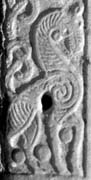
Object type: Cross-shaft
Measurements: H. c.127 cm (49.9 in); W. c.23 cm (9 in); D. unknown, but the eighteenth-century drawings (see below) suggests that this dimension was probably similar to the width.
Stone type: Very fine-grained pale white stone. Inaccessible, and therefore not examined in detail, but almost certainly oolitic limestone, the same as Wroxeter 3 below.
Plate numbers in printed volume: Ills. 562-4, 567, 792-3; Figs. 25M, 27K
Corpus volume reference: Vol 10 p. 314-7
(There may be more views or larger images available for this item. Click on the thumbnail image to view.)
Decorated cross-shaft. The shaft originally had a double border on three sides, the inner being plain, and the outer plain at the top and cable at the sides (the cable only survives on what is now the lower side as set in the wall). The lower part of the shaft is uncarved and this may have acted as a tenon to go into a socket in the top of the collar (see below). The carving is in low relief and split into two panels, both of which are complete. (i) The upper panel carries a well-conceived, median-incised plant-scroll with hollow-centred, tri-lobed leaf or berry bunches in the middle of each volute. The plant grows from a small, hatched, horseshoe-shaped object, very similar to those which perform similar functions on the Cropthorne cross-head (Worcestershire, this volume p. 353). Single fruit on straight stems grow from the nodes that mark the junctions between the volutes, while small, curling side-shoots fill the other interstices. (ii) In the lower panel there is a graceful, long-necked and long-legged, deer-like creature, whose tail is drawn out into a rather irregular pattern of median-incised interlace that fill the panel above its head. The creature's body and neck are covered with zones of contoured hatching, and the shoulder-joint is marked with a large spiral. The neck is bent over at the top so that the head points downwards. The jaw, carved as though seen from above, is rounded with fine inscribed muzzle lines down either side. The eyes are large, round and slightly concave, and are set on the front of the forehead. The ears are small, rounded and hollow-centred and stick out on either side of the head. The creature has small, rather dainty hooves. As with the dogs on nos. 2 and 3 (p. 317), the creature's legs are differentiated to give the illusion of depth, with those on the 'far side' of the animal being outlined with incised lines but with no hatching. Between the legs there are three large oval studs. A hole drilled through the creature's body just behind the spiral joint may be a pouring hole for jointing this section of the shaft to the lower part of the cross.
Three of the Wroxeter St Andrew carvings (nos. 1–3) can be identified on two pen-and-wash sketches, among papers deriving from the Shropshire antiquary, William Mytton, which show the cross when still standing, though without the cross-head (see Ills. 792 and 793). Mytton's papers were dispersed in 1877, and the sketches are now in two different collections. The first is an eighteenth-century drawing in Birmingham University Library (Special Collections MYT/7/1647, p. 183); this drawing is likely to date from c. 1733, the date of a drawing of the church building on p. 182 of the same manuscript (perhaps by a different artist). The second drawing, showing two faces of the cross and also probably of similar date, is in the collection at the Society of Antiquaries of London (MS 477, p. 411). An early nineteenth-century copy of this second drawing can be found in Shrewsbury (Shropshire Archives, MS 6001/6820, fol. 134). Moffett published this copy of the drawing (Moffett 1990, 9, fig. 17), and Dales also included the nineteenth-century copy together with a Shropshire Archives digital scan of the first drawing in her 2006 M.A. thesis (Dales 2006, 33–4, figs. 11, 12). The two drawings show the collared Anglo-Saxon cross-shaft that stood at Wroxeter until it was dismantled at an unknown date after the 1730s; the cross may have stood until very shortly before it was incorporated into the south wall of the church in 1763.
Wroxeter St Andrew 1 is the upper part of the shaft and nos. 2 and 3 (Ills. 565–6) are parts of the collar. The visible face of no. 1, now set high under the eaves on the south wall (Ills. 563–4), is so clearly identifiable on the sketch now in London (Ill. 793) that one can suggest, with some confidence, that all three of the other faces of the upper part of the shaft carried plant-scrolls and that at least one of these plant-scrolls was inhabited with birds and animals. The collar has dogs on two faces and a fan of foliage inhabited by a pair of small birds on the remaining drawn face, while the lower part of the shaft was divided into panels containing plant-scrolls, animals and birds enmeshed in plant tendrils, a small bush- or tree-scroll, and a panel of what may be fret. Both drawings show a fixing-pin at the top, presumably for the attachment of the lost cross-head (Ills. 792–3).
In her 2006 study Dales felt that the collared form of the cross-shaft set on a double-stepped base, as depicted in these drawings, 'has no precedent in the known corpus of Anglo-Saxon standing crosses' and that 'the sketches depict a reconstructed monument made up of two parts of cross-shaft ... with the addition of a third piece of sculpture inserted between them as a mid-section. This middle section ... was most probably a piece of architectural sculpture [possibly an impost block] from the Anglo-Saxon church ... [and] the monument in the sketches was constructed at a point probably not much before the sketches were made' (Dales 2006, 33–4). This suggestion is an intriguing piece of lateral thinking, but for several reasons it is not convincing. The stepped base may or may not be part of the original setting for the cross, but the shape of the shaft is not so unusual. Indeed there is a very similar collared shaft, carved from a single stone and ninth century in date, at Newent in Gloucestershire (Newent 1, p. 232, Ills. 392–7), while collared shafts of tenth-century date can be found at Bromfield, Penrith and Rockcliffe in Cumberland, Middleton in eastern Yorkshire, and Creeton in Lincolnshire (Bailey and Cramp 1988, 80–1, 136–7, 143–4, ills. 173–5, 489–91, 539–42; Lang 1991, 184–5, ills. 682–5; Everson and Stocker 1999, 139–40, ills. 124–7). Furthermore, when Dales made the suggestion she did not have the geological identification for these stones, which shows that the shaft and dog panels were all carved from oolitic limestone from the Cotswold Hills in Gloucestershire or Worcestershire. A carved panel depicting birds pecking at snakes (Wroxeter St Andrew 4, p. 318, Ill. 570), that survives built into the base of the chancel arch and was almost certainly part of a ninth-century church building on the site, is carved from sandstone from the local Salop Formation, while the oolitic limestone is specially imported — probably already carved. The present author, therefore, believes that all of the elements of the cross depicted in the eighteenth-century drawings are part of the original monument (but see below for its original location).
The Wroxeter cross has for some time been considered to be one of the 'Cropthorne' group of carvings (see the entry for Cropthorne 1 in the Worcestershire catalogue, p. 353, and the introductory chapters III and VI, pp. 25, 67), and all of the features common to this group are certainly present on the Wroxeter carvings. Here one finds the spiral shoulder joint and the face carved as from above that can also be found on Gloucester St Oswald 3 (Ills. 285, 286). The body of the long-legged deer is filled with zones of contoured hatching as at Acton Beauchamp, Cropthorne and Gloucester (Ills. 283, 500, 630, 632). This zonal hatching and the prominent spiral shoulder joint are strong indications that the 'Cropthorne' carvers were incorporating metalworking ideas into their designs. A parallel can be found in the design on the nose-guard of the Coppergate helmet from York (Wilson 1984, 67, ill. 64; Tweddle 1992, 969, figs. 431–2). Irish metalwork also offers parallels, for example the bell-shrine fragments from the Killua Castle collection, the openwork mount from Phoenix Park, Dublin, and the decorated plaque from Inchbofin Island, Co. Westmeath (Ryan 1989, 143–4, 150, cat. and ills. 137, 145, 146). The dog on Wroxeter St Andrew 2 (Ill. 565) has swags of fur like the beast at Gloucester and the upper beast at Acton Beauchamp (Ills. 283, 498), while the textured body-fill of the dog on Wroxeter St Andrew 3 (Ill. 566) is probably meant to be over-lapping layers of shorter fur. Both dogs have tightly curled tails like the Acton Beauchamp animal (Ill. 500). As noted above, the plant-scroll grows from a small, hatched, horseshoe-shaped object very similar to those which perform similar functions on the Cropthorne cross-head, and also at Acton Beauchamp (Ills. 499, 621). These objects have been compared to the domed clips which attach foliate ornament to the side frames on some West Saxon carvings (Plunkett 1984, i, 210; Cramp 2006, 51, 54). It is, however, possible that this hatched shape should be seen as a plant pot like those from which plant-scrolls grow on the opening folios of the Matthew and Mark gospels in the eighth-century Barberini Gospels (Vatican City, Biblioteca Apostolica Vaticana, MS Barb. lat. 570, fols. 11v, 50v: Alexander 1978, 61–2, cat. 36, ills. 174, 176–8). Hollow-centred fruit can also be found at Acton Beauchamp and tri-lobed fruits or leaves at Acton Beauchamp and Cropthorne (Ills. 498, 501, 633). This particular leaf- or fruit-form is also found on the late eighth- or early ninth-century narrow frieze from Breedon-on-the-Hill in Leicestershire (Jewell 1986, 96-7, pls. XLII, XLIII; Dales 2006, 40, ill. 22), and the Barberini Gospels again offers a manuscript parallel. From the eighteenth-century engravings it is possible to identify birds and beasts that can be paralleled on the three other carvings, and a bush- or tree-scroll like that on the Gloucester shaft (Ill. 281). The long-legged creature at Wroxeter is also similar to a creature on the collared cross-shaft from Newent (mentioned above, Ill. 400) and to a long-necked animal (albeit one with claws) that is part of the initial L of St Matthew's gospel from the later eighth-century St Petersburg Gospels (St Petersburg Public Lib., Codex F.v.I.8, fol. 18r: Wilson 1984, 88, ill. 110; Dales 2006, 43, ill. 32).
Since the drawings of the Wroxeter cross were discovered, it has usually been assumed that the cross stood in the churchyard (Moffett 1989, 5; White and Barker 1998, 140). It is therefore important to note that the two surviving drawings give no specific indication of the location of the cross. While the cross may indeed have stood in the churchyard, it would have to have been set in an exceptionally sheltered spot for the carvings to survive in such good condition on the visible north face of the upper part of the shaft and on both the north and south faces of the collar. Instead the possibility should be considered that the cross may not have stood outside throughout its history, and that it was standing inside the church before being reused as building stone in 1763. Just possibly an entry in the churchwardens' accounts early in the year 1763–4 for the modest sum of 2s 6d for carrying stone out of the church, might relate to the removal of the cross (Shrewsbury, Shropshire Archives, P318/B/2/4).
In Domesday Book four priests are recorded at Wroxeter (Thorn and Thorn 1986, no. 4, 3, 26), itself a strong indication that Wroxeter was a significant minster church before the Norman Conquest. There is no written evidence for Wroxeter in the Anglo-Saxon period. However, Steven Bassett (1992b) has examined the parochial origins of the Wroxeter area in a detailed study, and has concluded that the minster at Wroxeter was of very early date; he tentatively suggests that the church may have been of British origin and that it was in any event functioning as an important minster in the Middle Saxon period.
