Select a site alphabetically from the choices shown in the box below. Alternatively, browse sculptural examples using the Forward/Back buttons.
Chapters for this volume, along with copies of original in-text images, are available here.


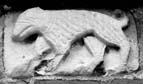
Object type: Panel from cross-shaft collar
Measurements: H. c.20 cm (7.9 in); W. c.40 cm (15.8 in); D. unknown
Stone type: Inaccessible and therefore not examined in detail, but almost certainly oolitic limestone, the same as Wroxeter 3.
Plate numbers in printed volume: Ills. 565, 568, 792-3, Fig. 25N
Corpus volume reference: Vol 10 p. 317
(There may be more views or larger images available for this item. Click on the thumbnail image to view.)
Panel with carving of dog, facing left. Part of the collar of a cross-shaft (see no. 1 above). The dog is carved in high relief on a rectangular panel. The animal's body is outlined with a narrow, incised border and covered with overlapping, round-tipped swags of fur. The tail is short and curled upwards. The head is rounded but damaged so that most of the details of the eyes and ears have been lost. The jaws are long and narrow, with incised grooves on the upper part of the muzzle and across the cheek behind the long, closed mouth. There is a small, round nostril. There are three incised bands around the creature's neck. The central band may be a collar, with circular studs carved around it. The legs are relatively short and the three-toed feet are large. The two legs on the 'far side' of the animal are carved in lower relief that the nearer legs, so emphasising the three-dimensional nature of the carving. The 'background' legs are outlined, but carry no swags of long fur.
See Wroxeter St Andrew 1.
